
This feature film is available on November 18th as a “Limited Edition” Blu-ray from Radiance Films.
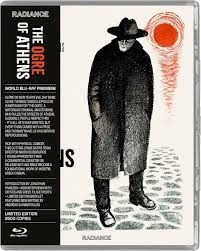
Most movie fans certainly think of themselves as being well-versed and having seen a great deal of notable pictures. It seems like every month Radiance Films finds and releases another hard-to-find yet incredible film from Europe or Asia that I hadn’t been aware of. And in many cases, it truly is incredible to discover so many gems that haven’t been available in North America. They’re keeping that remarkable streak running with The Ogre of Athens, aka O Drakos, a Greek picture that flopped during its initial release, but is now considered a classic and one of the country’s all-time best.
Now, Radiance Films is releasing a “Limited Edition” Blu-ray of the feature. While the original materials used in the high-definition transfer aren’t in pristine shape, this is still an impressive disc and presents the best available version of the movie. It also comes with a few interesting bonuses that give insightful background about the cinema of Greece during the era and the recurring themes of the title.
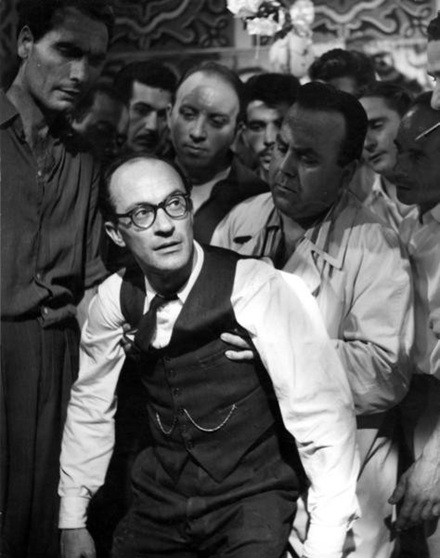
The plot follows Thomas (Dinos Iliopoulos) a timid and mousy civil servant who is lonely, but also doesn’t seem willing to socialize. Not that there are many people around for Thomas to befriend. Most of those introduced in the film are selfish, and even the lead’s landlord hates him and wants him out. Just as New Year’s Eve is about to arrive, an article appears in the local paper. It features feared criminal mastermind The Dragon (or The Ogre), who bears a striking resemblance to Thomas. When Thomas goes out that evening and visits a club, he is mistaken for the crook. People are suddenly afraid and treat him favorably, and women begin approaching him. At first, Thomas is taken aback, but he soon appears to enjoy the attention and power he is receiving from others. But it isn’t long before he’s drawn into a heist plot run by the club manager and his lies result in a life-threatening situation.
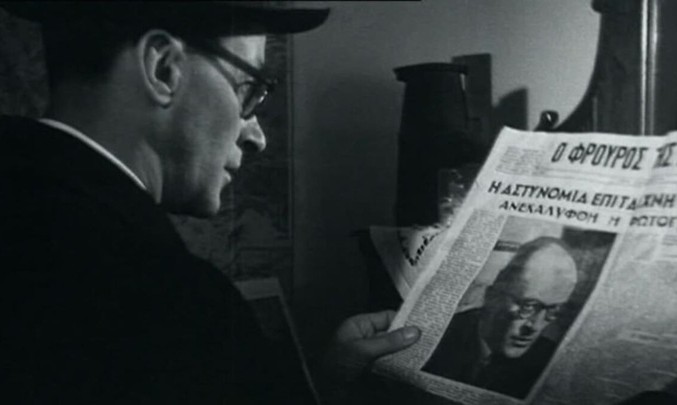
As noted, the film starts with a satirical tone as the shy figure is first treated poorly, before being mistaken for a major crime figure. His reactions are very entertaining as he slowly realizes that this persona is raising his public stature. A lot of the film takes place in the club, and there is a hilarious moment when Thomas sees threatening, dark-coated figures entering the establishment during a lively dance number. They try to bounce in time to the music as they stiffly make their way through the club and towards their target. It’s a very funny sequence.
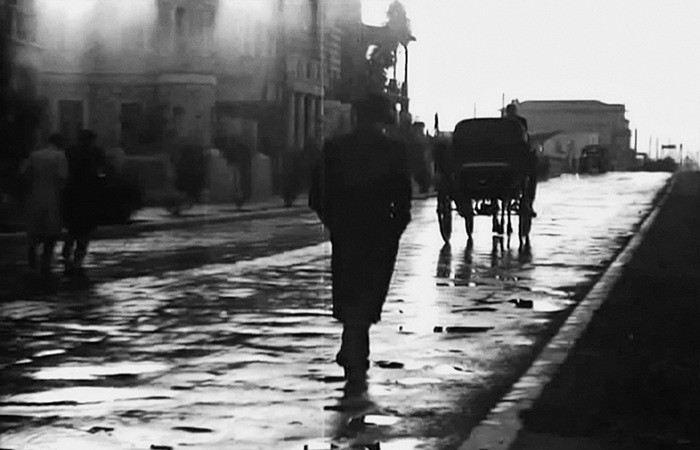
The satire is solid, showing how difficult life was at the time. Greece was occupied by Nazis during World War II, and shortly after its end went through a brutal civil war. A far-right wing government took control, leaving most citizens poor and struggling to get by. The buildings and streets (which are real locations) look beat up and there’s a general sense of despair to the surroundings. Policemen aren’t any help to the public and appear corrupt, and the public is suffering so much that it isn’t surprising to see them taking advantage of each other. The world presented is a dangerous one, and while there is a strong element of comedy early on, the film can’t help but delve into those darker realities as it progresses.
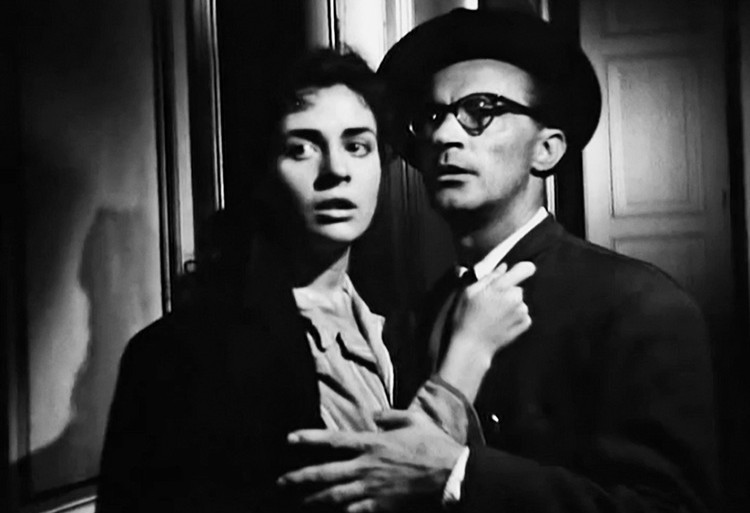
There’s also a relationship between Thomas and a dancer at the club that’s surprisingly sweet and effective. The two become close and he discovers they share some of the same thoughts about loneliness and worries about life in general. Events take an effectively grim turn when Thomas’ real identity begins to come to light. The crooks depending on him to help start up their profitable scheme become fearful, the police are untrustworthy, and a local soon gives away Thomas’s identity. By this point, the humor dissipates and it all ends on a memorably tragic note.
This is a strong film that pays homage to Italian neorealism while still having its own unique voice. The picture quality on the Blu-ray is the best currently available. It’s admittedly imperfect, and a few scenes have marks or scratches on the print (the opening scene being one such example). There is also an occasional bit of softness, but this is due to the original photography and not the transfer. It’s not too distracting and otherwise the release contains impressive and sharp photography, specifically in the club and during a few exteriors (like a streetcar).
The Blu-ray also contains some great bonuses. There is an intro to the picture (that can also be watched as a standalone extra) with author Jonathan Franzen, who has written The Corrections, Freedom and Crossroads among many other notable titles. He talks about seeing this picture in his early 20s and states that it had a lasting impression on him, inspiring many aspects of Freedom. Franzen also mentions that, having recently revisited the movie later in life, he had misremembered certain elements (which is probably for the best, at least in the case of his famous novel). He goes over exactly what impressed him about the picture and its lasting effect on him.
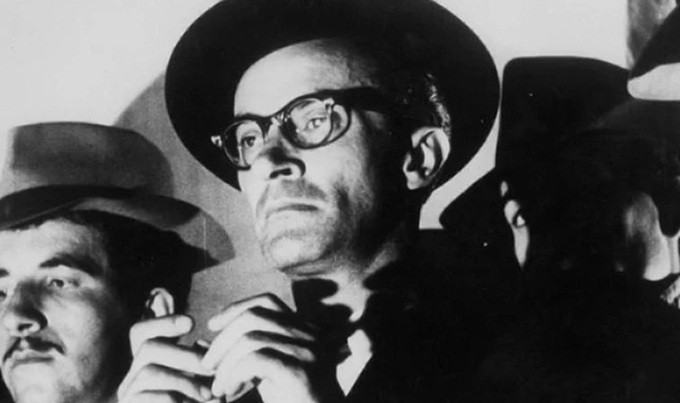
In another segment, film critic Christina Newland talks about director Nikos Koundouros and his struggles during his career. This particular film was made at the end of the country’s civil war and depicts the financial hardships of life in Greece resulting from a harsh rule. He had been imprisoned by the government and many of his works were censored because of their leftist views. While this picture was well-received by international festival audiences, it didn’t do well in its home country. Only decades later was it recognized by Greek citizens as being an effective satire and critique of the country and its attitudes of the time. She notes that the film’s morally gray characters were a part of the problem for audiences of the day, who didn’t like the less-than-patriotic tone of the picture. She also is impressed by one of the final images after a violent act that takes place in front of a tourism banner. This is another informative and interesting piece.
There is also a discussion from movie expert Dimitris Papanikolaou about this picture and its place in Greek film history. While many consider the “Golden Age” of Greek cinema to be from a period slightly after this picture and hitting its height with mid-to-late 1960s titles like Zorba the Greek and Z, that impression began changing with reevaluations of titles like this one. It’s another piece that will entertain and give viewers ideas on more features to check out.
A booklet is also included with essays on the title and an appropriate extract from Jonathan Franzen’s novel Freedom.
While one hopes that even more restorative work can be done on the original negative of this film, The Ogre of Athens has still never looked better. This is certainly as good as the movie can currently look, and the Blu-ray arrives with great extras that help give an even better understanding of the background of the production and life in Greece during this period. I’m happy to have been introduced to the feature, and any classic world movie fan would be well advised to check this release out.
