
This “Limited Edition” box set from Arrow Video is now available for purchase.
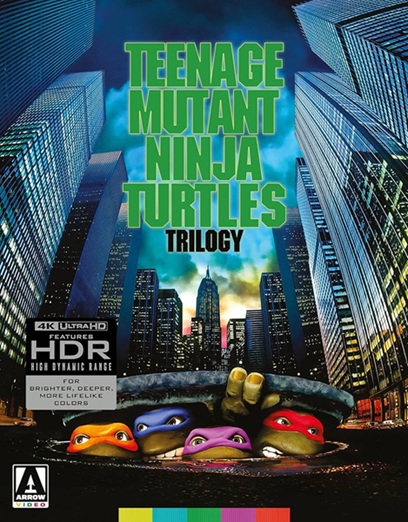
The edgy independent comic book Teenage Mutant Ninja Turtles was something of an underground sensation when it was first published in the mid-1980s. Few besides those frequenting comic shops knew about the title, but that all started to change once the property was licensed as an animated series for kids. Even then, adults were largely unfamiliar with the property.
That is, until Golden Harvest and New Line Cinema debuted a trailer for a live-action feature film adaptation. Teenage Mutant Ninja Turtles (1990) was a massive box office smash and the characters were suddenly everywhere. Two quick sequels, Teenage Mutant Ninja Turtles II: The Secret of the Ooze (1991) and Teenage Mutant Ninja Turtles III (1993) followed. By then, the franchise’s popularity had peaked, but the characters have never really gone away. More successful animated shows and features continue to be produced to this day.
Arrow Video is going back to the original films and releasing them in a “Limited Edition” 4K set. This is an impressive package, with upgraded transfers of the movies as well as tons of bonuses, including commentary tracks with all of the directors involved. Fans shouldn’t expect reference quality visuals on the first two titles even though they have been given new restorations and are presented in Dolby Vision. For the original, the transfer was taken from the original 4K camera negative. It isn’t the sharpest, but that’s how the movie was lit and filmed, so it looks as good as it possibly can under the circumstances. People tend to forget that these were relatively low-budget productions featuring a significant portion of dark photography.
The same issue is true of the first sequel. There are impressive moments, but several bits in the film have a lot of natural film grain. However, the third title, while having a smaller budget than the first follow-up, does look sharp and striking in 4K. This 4K interpositive doesn’t have noticeable grain and at times looks spectacular. For fans, the picture on part three truly is striking and should wow series enthusiasts.
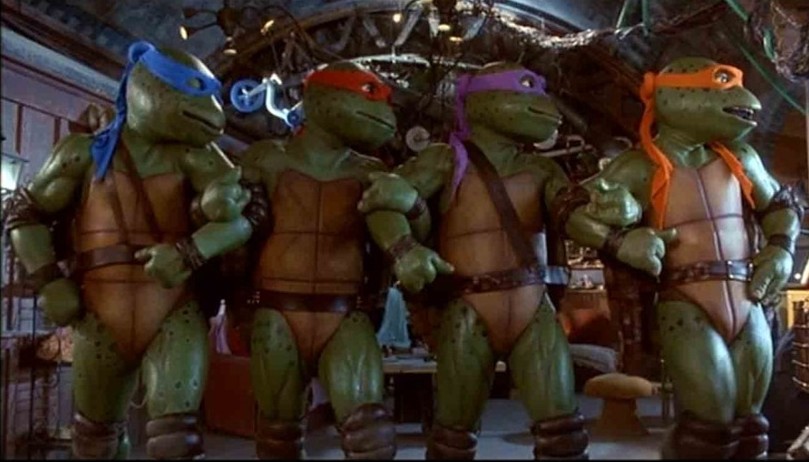
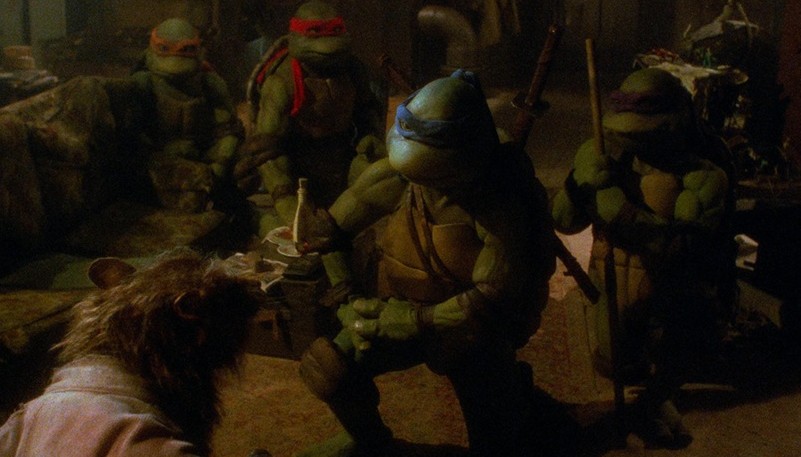
Teenage Mutant Ninja Turtles is set in New York, with city residents terrified by a crime wave. The sinister figure The Shredder (James Saito) and his crew are responsible, manipulating the teen population into committing robberies for them. One night after leaving work, reporter April O’Neil (Judith Hoag) is attacked by some of them. She’s rescued by a group of four, anthropomorphic, human-sized turtles with martial arts skills. Named Leonardo, Donatello, Raphael and Michelangelo, the quartet explain that, as baby turtles in the city’s sewers, they came into contact with a substance that mutated them. Then, they introduce their caregiver and master, Splinter, a rat who went through the same process. The team loves fighting crime and eating pizza. They agree to help take on the imposing antagonist, also encountering vigilante Casey Jones (Elias Koteas) in the process.
The film does an excellent job of keeping the story grounded in the real world and presenting The Shredder as a significant threat. Ahe movie doesn’t talk down to its audience. It gives each character a distinctive personality and places them all in dangerous situations. The action sequences involving the characters are exciting and it’s amusing to see the human characters react to the large shelled heroes with shock, surprise and, in true New York City fashion, indifference. The puppeteer and costume work from Jim Henson Studios is exceptional as well. Hoag and Koteas are another big plus as the human leads. They have plenty of onscreen chemistry and interact seamlessly with the fictional fighters. Another great bit is the unexpected appearance of future star Sam Rockwell as leader of the teenage gang.
In the end, it’s an original and dynamically told tale. One can easily understand how it became a surprise hit, grossing over $200 million dollars during its run at theaters. The extras on the disc are fascinating as well, showing that it was a real struggle to get the movie completed. First, there is a solid commentary track from a comic book expert who delivers some fascinating background on the origin of the characters and their history in general.
But the highlight is a great commentary track and a recently recorded interview with director Steve Barron. Among many other details, he discusses the early part of his career as the music video director responsible for the A-ha video of “Take on Me,” Bryan Adams’ “Summer of ‘69” and “Run to You” as well as “Money for Nothing” from Dire Straits, “Don’t You Want Me” from Human League and many more iconic clips.
Barron notes that working in music made him aware of the youth market and what would appeal to them. Golden Harvest had picked up the film rights to the franchise, but were unwilling to spend more than $5 million dollars on the feature, with an extra $2 million from New Line Cinema for the US release rights. Yet, very few executives seemed to believe in the project. Barron called in favors and convinced Jim Henson to do the turtle suits, which worked wonderfully. Despite how big it all looks, Barron notes they shot the film for $7 million and change (some sources state $13.5 million, but Barron would dispute that figure). They filmed a few exteriors in New York, but everything else was shot in North Carolina.
When principal photography and the first cut was all finished, Barron was generally pleased, but wanted to fix a few things with reshoots and asked for another $750,000 dollars. Golden Harvest refused, and when the director asked around to see if he could raise it himself based on how exceptional the movie was turning out, his relationship with Golden Harvest soured. He was fired and the film was released in theaters as is. At least Barron got the last laugh, as it turned out to be a massive success based largely on his skills as director and storyteller. Producer Simon Fields is also interviewed and discusses he and Steve Barron getting involved in the project.
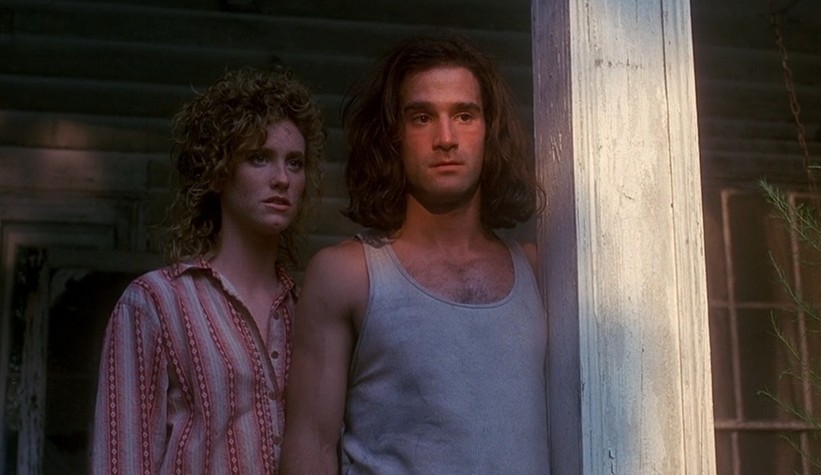
There is also an enlightening discussion with Judith Hoag, who played April O’Neil. She talks about working on the set, stating that she had a great time with cast members like Koteas and the crew, while also being aware of how difficult and time-consuming it was for the actors and puppeteers to create the turtles. There’s also a great story about the other movie she was working on at the time called Cadillac Man. Star Robin Williams would ask where she was running off to during breaks in filming, and when she sheepishly mentioned the Teenage Mutant Ninja Turtles movie, his eyes lit up. He knew about the comic book and characters and would make sure that she wrapped early in order to get to the other set. Hoag also remembers being pleased with the film, but very disappointed that she never received a call from Golden Harvest to reprise her role in the follow-up.
Additionally, there is a discussion with the turtle performers that goes into the challenges of creating live-action versions of the iconic characters. And another chat with puppet coordinator and second unit director Brian Henson, as well as another individual heavily involved in this part of the project. A featurette on the North Carolina and New York locations is also included, in addition to an alternate UK version that has new bits of footage replacing a couple of moments censored by the British Film Board. An alternate, extended ending from the VHS workprint is also included (it consists of a bit more joking around from the characters), as well as alternate Korean footage and promo materials. The iconic teaser is there – this bit of advertising did a lot to sell the picture to North American audiences and got a huge reaction when it played in cinemas.
I’ll be honest and admit that I wasn’t nearly as big of a fan of Teenage Mutant Ninja Turtles II: The Secret of the Ooze (1991). To me, it felt like a bit of a rush-job meant to cash-in on the success of the first film. When the first picture arrived, there was a lot of criticism directed at it from parent groups, and this effort took those complaints to heart. It really dialed back on the action and tension the first tale possessed, focusing on a younger demographic and emphasizing broad humor over action. For me, it doesn’t work at all, but I know people for whom this effort made a bigger impression.
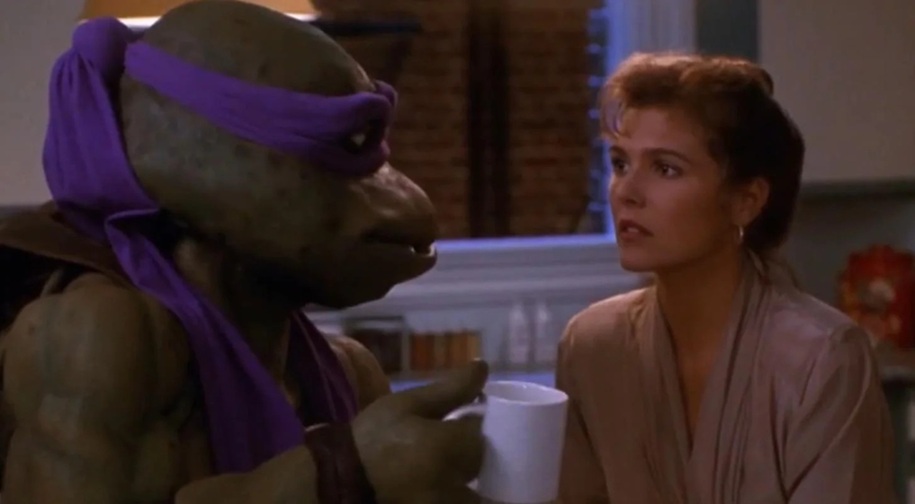
The movie sees The Shredder (Francois Chow) having actually survived the climax of the original film. He and his gang set up new quarters in a junkyard. Meanwhile, April O’Neil (now played by Paige Turco) is investigating the Techno Global Research Institute, who may have been responsible for the ooze that mutated the turtles many years ago. Professor Jordan Perry (Daivd Warner) wants to study the substance and find a cure for the mutations, but is kidnapped before he can do so by The Shredder. The villain uses the ooze to create two new mutant monsters, Tokka and Rahzar. Unfortunately, these mutants have the minds of infants and aren’t as dangerous as hoped for. The turtles try to rescue the kidnapped scientist and cure Tokka and Rahzar of their mutations.
There are a couple of funny moments. The first is an opening montage featuring literally everyone in New York City chowing down on pizza. And the dance club climax with the heroes trying to stop The Shredder while Vanilla Ice performs a set in the background (that even David Warner’s character dances to) is so bizarre and outrageous that it does generate laughs.
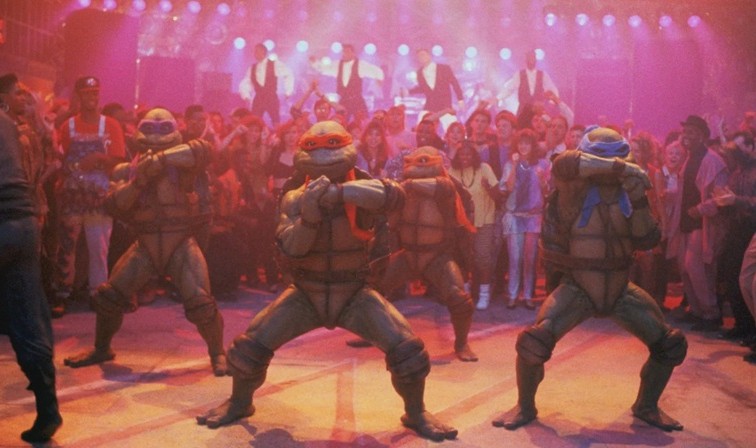
However, there’s little to no tension in the story. The new mutants knock over a couple of telephone poles, but otherwise do not pose any kind of threat. Much of the film is set in April’s apartment or the junkyard and the gags and situations aren’t thrilling. There are also odd plot holes. At one point, the heroes are captured in a net and for some reason cannot escape, despite swords and other sharp weapons being visible on their shells. Even though it had a bigger production budget, the movie doesn’t look any more polished than its predecessor. The 4K transfer of the interpositive highlights this deficiency. With the exception of the club scene, it looks just as grainy as the original. But again, the photography was always a little darker on purpose in order to hide the seams of the heroic characters, so this is to be expected.
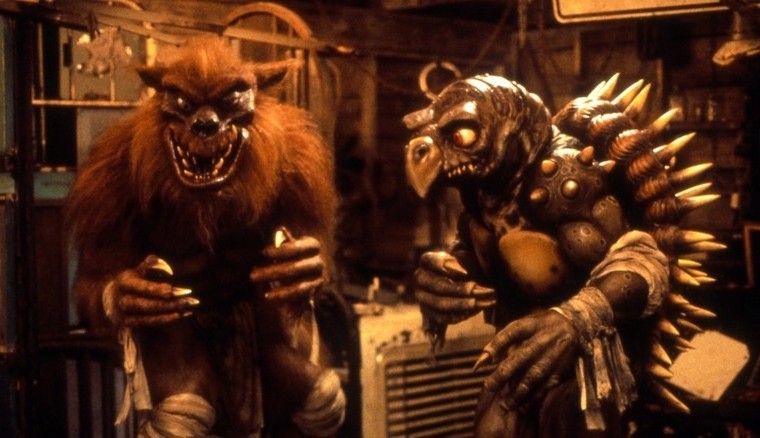
Despite me not being a fan of the movie, I was impressed with the bonus material. There is a new commentary with director Micheal Pressman, who is open about his role in the production. He worked largely in television and admits he wasn’t really aware of the characters. Pressman was told by a notable young actor on the show he was directing that he should take the job. The filmmaker assumes he was picked by Golden Harvest and New Line because he had directed The Bad News Bears in Breaking Training, another family-friendly picture. You won’t get any details from him about the casting. The filmmaker states he has no idea why the April O’Neil role was recast. Instead, he focuses on technical details that involve using long takes and following classic film comedy set-ups for the turtles. Pressman also suggests that great actor David Warner accepted his role because of his daughter, who liked the characters. Warner was excited to work on a picture that she could see.
There’s an interview with the score composer who goes over his work on all three pictures. You’ll also get a discussion with the mold shop supervisor on making the turtle and creature prosthetics as well as a talk with the editor on cutting the action. An archival featurette, trailer and image gallery are also included on the disc. The film ended up grossing a solid $78 million on a $25 million dollar budget. So, while it may not be my favorite title in the series, there is a fanbase for it. And even for me, the bonuses add plenty of insight into what was going on behind-the-scenes.
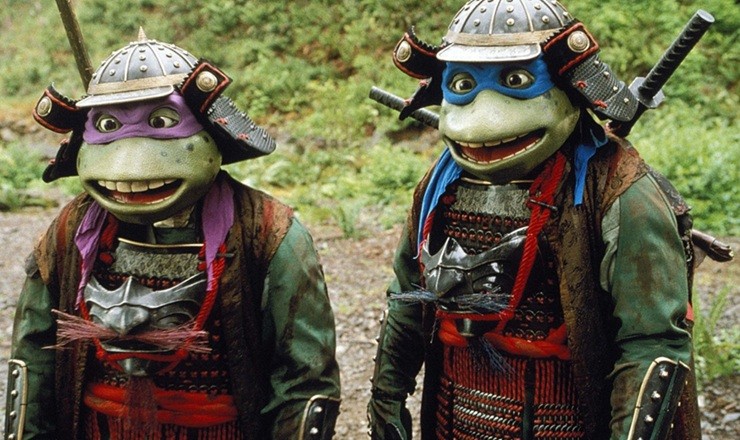
The last title in the original trilogy was Teenage Mutant Ninja Turtles III, which is a surprisingly underrated entry. This movie attempts to add a bit of edge back into the proceedings and is more ambitious with its story of Donatello, Raphael, Leonardo and Michelangelo being transported into feudal Japan. It also wisely brings back Casey Jones, even if the character isn’t as involved in the central action as much as one might hope for. Back in its day, critical reception towards the movie was poor, but that was mainly due to the overexposure of the characters that had been occurring over previous years.
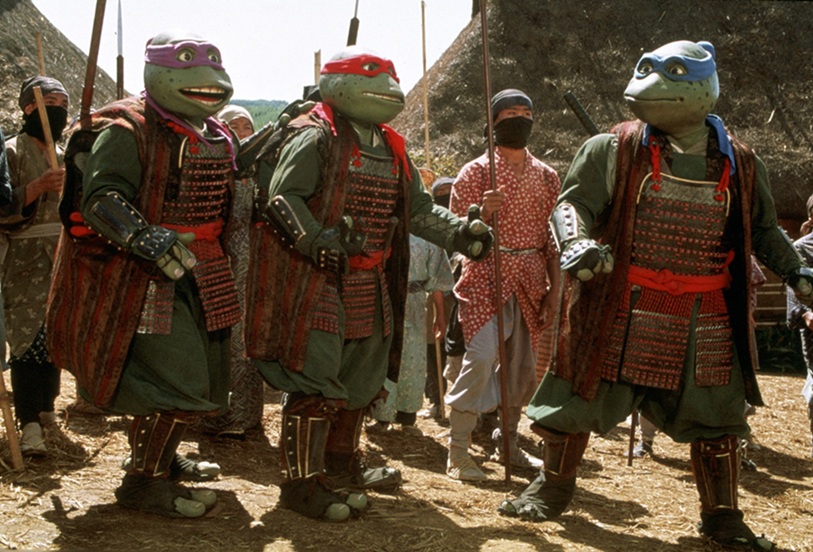
The plot involves a mysterious scepter that April O’Neil (Paige Turco) finds in an antiques shop. When she visits the turtles, they discover that it can open the gates of time. And back in feudal Japan circa 1603, son Kenshin (Henry Hayashi) of Lord Norinaga (Sab Shimoto) come across a similar item. It causes a rift that sends Kenshin to New York and April to Japan. The turtles realize they have a limited window to travel back and retrieve her. So, they get right on it, trading places with four of Lord Norinaga’s warriors, whom Casey Jones (Elias Koteas) must keep safe in New York. Now in Japan, the group face a warlord, as well as mercenary Walker (Stuart Wilson) and ex-prisoner Whit (also Elias Koteas) whose loyalties are unclear.
Not all of the film’s gags work, but there is plenty of enjoyable back and forth between the turtle characters. It’s exciting to see them all ride horses and do battle with swords again. The sets are large and impressive, the characters even get some time to interact with locals and form sweet relationships, and the threat from the nasty Walker is well established. The movie might not go all the way back to the tone of the original, but it is exciting, and features a unique story with impressive action and memorable moments. One such gag is when the turtles arrive in feudal Japan. They find themselves on horseback, with one member riding in reverse and unsure of what to do. And Casey Jones is hilarious as he attempts to modernize the warriors and teach them the rules of hockey.
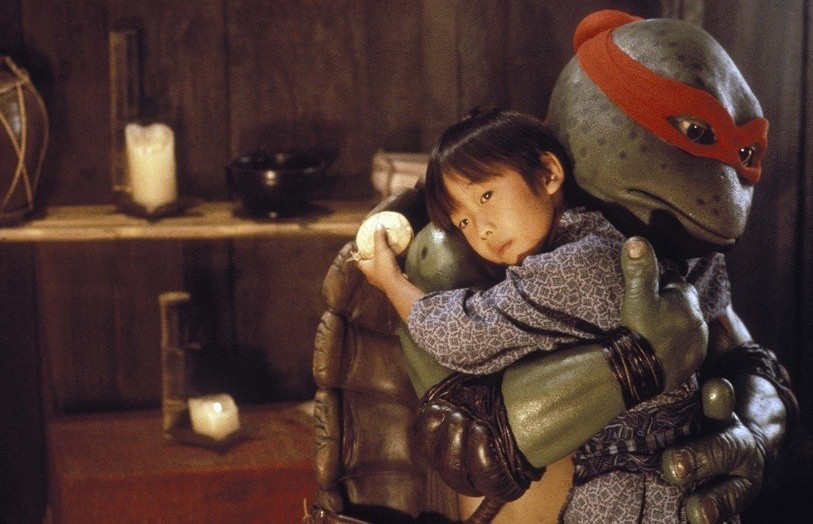
There is plenty of good stuff in this film which makes it a more satisfying follow-up than the previous chapter. It also looks lavish in comparison to the previous chapters. While the budget was lower for this effort, the natural location photography is gorgeous and the sets are impressive throughout. There’s an epic, climactic battle featuring a great many extras that also makes an impression. The 4K interpositive is very clean and sharp and everything looks wonderful in this picture. While general audiences may have been tiring of the characters by this point (the movie was modestly profitable, making $55 million dollars on a $21 million dollar budget), the final product holds up very well.
And again, the bonuses are great. The first is a commentary from director Stuart Gillard. He discusses having to pitch and sell the sequel to TMNT creators Kevin Eastman and Peter Laird. Apparently, he had five different story ideas, but the one everyone was the most excited about was the time-travel tale. So, that’s the picture that he wrote. Gillard discusses the difficulties in making the movie, and having his essentially blind turtle actors have to ride horses and perform elaborate, time-consuming stunts. He jokes about being mad at the writer of the picture (he wrote it) for inventing such complicated set-pieces.
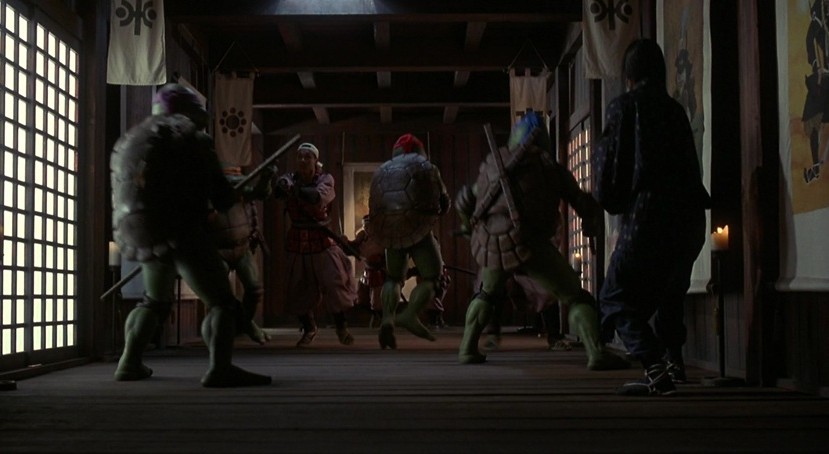
He also notes how great it was to work with countryman Elias Koteas and get him back into the series, even if the character is sidelined a bit. One of the things mentioned was that executives wanted all the focus to be on the turtles fighting, and that it was a fight to get his human characters screen time. Still, the filmmaker was ultimately happy with the end product and its uniqueness in the franchise.
This disc also contains an interview with Sab Shimono. He, like David Warner, wanted to be involved in a production that kids could watch and was pleased to be involved in the picture. Additionally, co-star Vivian Wu talks about her career as an actress (including her debut in The Last Emperor) and working with the cast and crew on this project. An alternate UK opening is including, along with a theatrical trailer and an image gallery,
The ”Limited Edition” 4K Ultra HD Teenage Mutant Ninja Turtle Trilogy collects all titles in the original series in an impressive package. It seems that there are many differing opinions of which ones are better than others, but I’ve shared my views and others are now invited to watch or revisit the pictures and make up their own minds.
You do have to cut the first two titles some slack in regards to 4K picture quality, as there is a fair amount of natural grain that can’t be removed. At least the third title looks consistently wonderful and will impress anyone who checks it out. Overall, the set provides the best possible transfers and fascinating facts about the histories behind the productions that reveal unknown stories about the movies. For that reason alone, the set is worth picking up.
