
This ‘Limited Edition” Blu-ray from Radiance Films is now available for purchase.
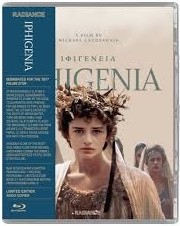
I haven’t read up on Greek myths in many years, and while I’m aware of several figures and stories, Iphigenia isn’t one that I’m immediately familiar with. It’s a memorable story about a king who offends a goddess. As punishment for crimes committed against the temple of the deity, he is told that he must sacrifice his oldest daughter. Obviously, that’s about the worst punishment one could possibly imagine, leading to plenty of drama. The story has been relayed many times over the years, both with happy and downbeat endings, which also means that viewers don’t always know how things are going to wrap up when they see a new adaptation.
One of the most striking cinematic versions is Iphigenia (1977), a Greek feature that embraced all the tragic aspects of the story. It was nominated for both a Palm d’Or and an Academy Award for Best Foreign Language Film and it is clear to see why. This is an impressive production with beautiful photography and a large scale with numerous extras. Yet it is still focused on the personal drama emphasizing the characters and the situation over any sort of action and spectacle.
Radiance Films has just released a “Limited Edition” Blu-ray of the movie that delivers a very sharp presentation of the film, along with some supplemental material that will give viewers important background information about the title and this unique telling of the story.
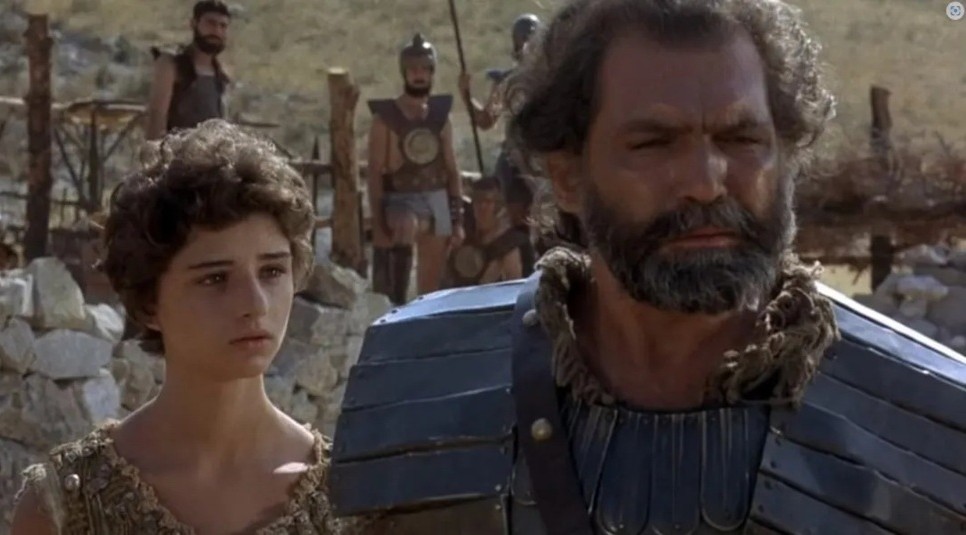
For those who haven’t seen it, the story begins just before the start of the Trojan War. Greek Mycenaean King Menelaus is about to send his armies across the Mediterranean Sea to Troy in order to collect his wife, Helen, who has left him for the king ruling that land. Unfortunately, the entire army, led by Agamemnon (Kostas Kazakos), is grounded on the coast when the east wind dies out. The army is ready to fight, anxious and getting increasingly annoyed of waiting in the stifling heat for conditions to improve. In fact, they’re ready to turn on their leader. In order to calm them down, Agamemnon allows his soldiers to raid a farm, and in the process, they end up killing a sacred deer of the god Artemis. Word comes from Agamemnon’s estranged brother and fellow leader Menelaus (Costas Carras) that Artemis’s spokesperson/oracle (Dimitris Aronis) says the god is angered by this act of violence. As punishment, the king must sacrifice his eldest daughter, and only then will the winds begin blowing eastward.
Naturally, Agamemnon is horrified by the demands. After trying to talk his way around it and arguing with Menelaus for some time (in the process pointing out his brother’s selfish reasons for wanting the sacrifice to go ahead), he ultimately relents. His army is about to turn on him, guaranteeing failure for the mission and the end of his own life. So, Agamemnon concocts an elaborate scheme, sending false word home that his teenage daughter Iphigenia (Tatiana Papamoschou) is to be married to Achilles (Panos Mihalopoulos), the greatest of all Greek warriors, and that she should be sent alone to him to take part in the quick nuptials.
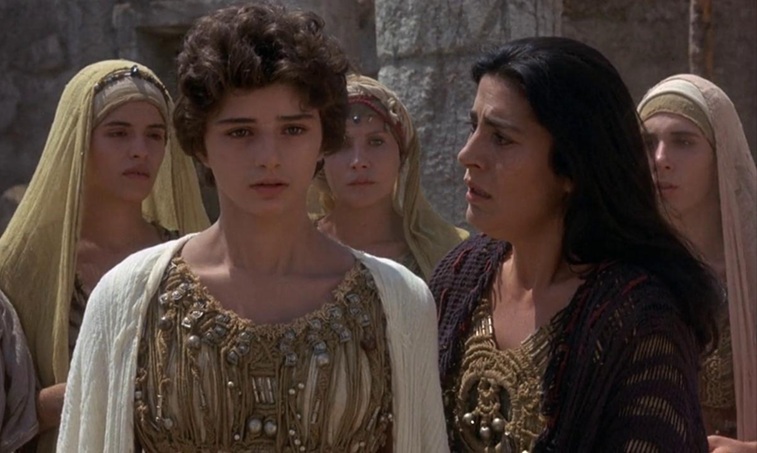
Her mother, Clytemnestra (Irene Papas) ignores the stipulations, traveling with her daughter to prepare for the wedding. The figure’s arrival forces Agamemnon into a web of lies that is soon undone when Clytemnestra starts asking questions. This includes finding Achilles, who is completely unaware of this wedding. He’s so furious at being used by the king that he states his willingness to stand and protect Iphigenia from any kind of harm. As the army gets word of the sacrifice and threatens to brutally slaughter the girl themselves, things turn ugly, leading to tragedy.
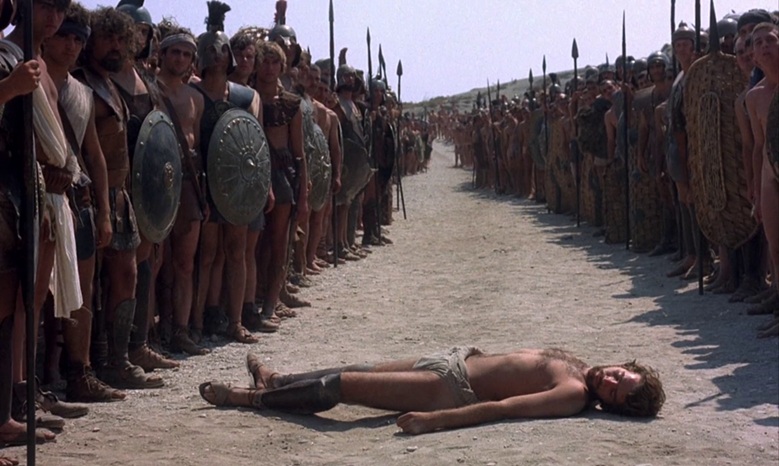
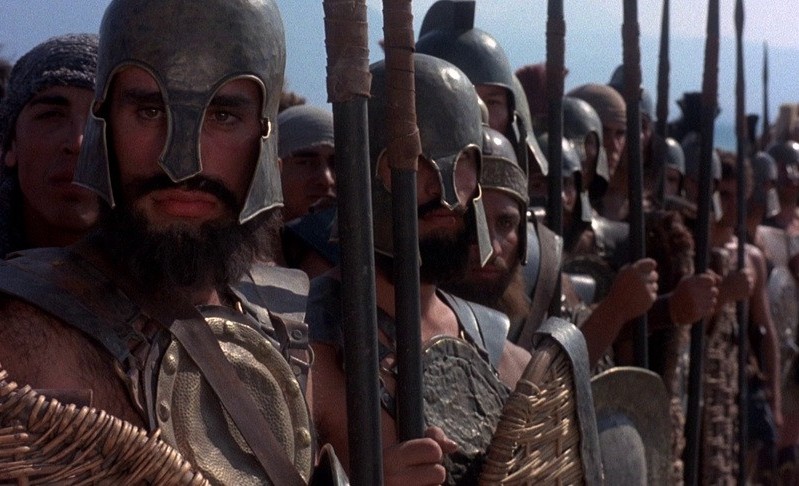
This is a very interesting update of the story. While fantastical, it does try to add some realism to the storytelling. We see the army suffering early on in the sweltering heat without much consideration from their superiors. They lack the proper supplies, passing the time trying to avoid overheating and sweating profusely. Additionally, the movie doesn’t really show the gods as being real entities, with the demands coming exclusively from human oracles. During the climax, the film subtly suggests that these deities may not be all- powerful or perhaps real at all, as the weather begins to change well before the sacrifice occurs.
The drama between the characters is well-handled, with young Papamoschou making a strong impression. The princess does eventually learn that the plan is to sacrifice her. After getting over the initial horror of what might occur, she ponders the potential outcomes, and what might happen to her family if she doesn’t go through with the ceremony. It all leads to a powerful climax that, while dark, certainly keeps viewers engaged in the proceedings.
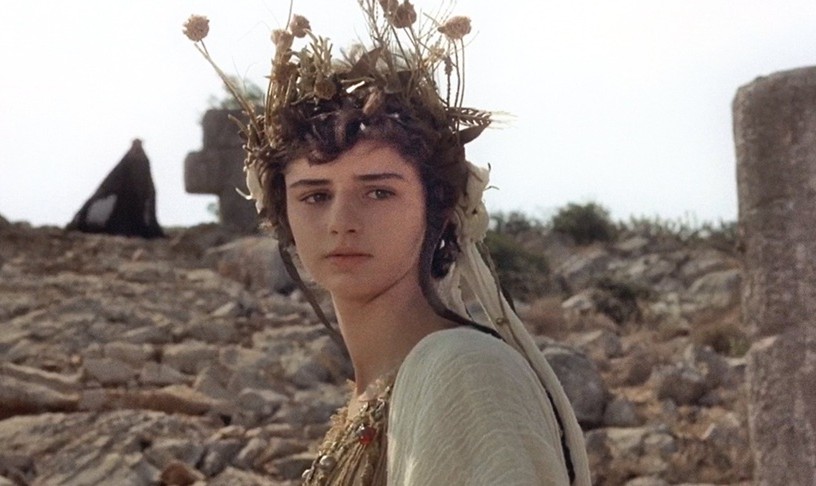
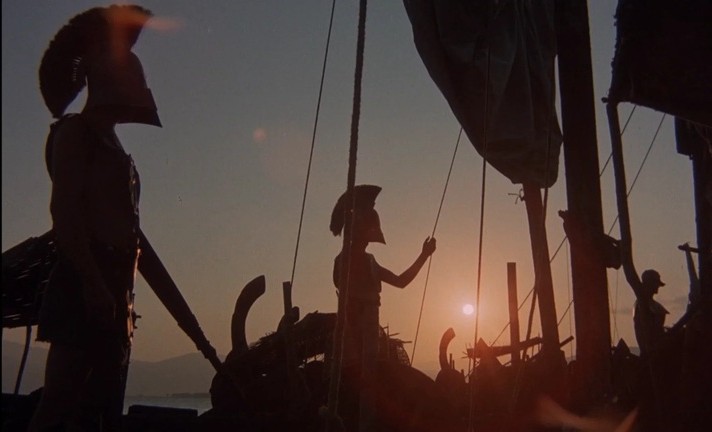
It’s an excellent film and, once again, Radiance Films has taken great care with the “Limited Edition” Blu-ray release. This is a high-definition digital transfer, and it looks very good. Admittedly, the opening optical titles have speckles and dirt present, and the closing credits do look a bit worse for wear, but the feature itself is quite sharp and crisp with minimal grain and almost no speckles. The cinematography is impressive, with shots that occurred during magic hour. Images on the beach with the large army and warships are also striking (mostly because hundreds of real extras are being used, as opposed to computer effects).
Included on the disc is an interview with a Greek film expert on the movie and its director, Michael Cacoyannis. This was part of a well-regarded trilogy of classic Greek myth stories that the moviemaker helmed (along with Electra in 1962 and The Trojan Women in 1971). Curiously enough, each story in the series takes place earlier than the one before it.
The film historian notes some of the changes made from the original legend (particularly with the beginning and end of the picture) and makes a case for the strong female characters in the story. Praise is also heaped on the director for making the environment look incredibly hot and uncomfortable, with the characters covered in sweat.
There is also an interview from Cannes with director Michael Cacoyannis and actress Irene Papas in which the filmmaker details why the story still resonates today (which would have been in the 1970s) as well as its themes. Footage from a press conference is also included, where Cacoyannis discusses his casting decisions and working with the actors.
A book with writing on the movie is also included. And, like all other titles from the distributor, it all comes packaged in with a removable OBI strip.
It’s been a while since I’ve read about or seen any pictures based around Greek myths, but these stories can still make an impact on modern audiences. The decision to add a few unique updates to the storytelling and the film;s themes really make it stand out as an impactful title, even many years after its initial release. If that wasn’t enough, the disc’s supplements are also helpful in adding even more layers to the movie. Iphigenia is another great Blu-ray from Radiance Films and gets a big recommendation from this reviewer.
