
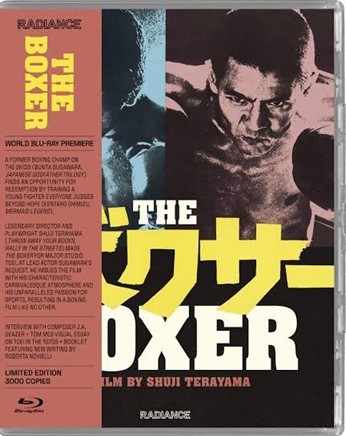
This “Limited Edition” Blu-ray from Radiance Films is now available for purchase.
If you were around in the late 1970s, one of the biggest titles of the era was Rocky. The relatively small 1976 Oscar-winner inspired all sorts of similarly themed titles, from the Muhammad Ali biopic The Greatest, the Clint Eastwood effort Every Which Way but Loose, The Champ with Jon Voight, the prison-boxing picture Penitentiary, Rocky II and eventually Raging Bull in 1980.
But there were even more features that were produced in other parts of the world. One of those is now arriving as a “Limited Edition” Blu-ray from Radiance Films.
The Boxer is a Japanese feature from Toei Company Ltd., with a slightly grittier tone than Rocky. It didn’t make a big splash in its homeland, and essentially didn’t even get released in North America. Time has been kind to the picture though. It holds up as an effective spin on the boxing feature with a naturalistic tone with a few unique and visually creative flourishes.
Hayato (Bunta Sugawara) is an ex-boxer who once showed great promise in the ring. However, after rising in the ranks and becoming a champion he quits. In fact, this literally occurs during the middle of a match, as Hayato allows himself to be clobbered until he drops. Now, he wanders aimlessly. He has become an alcoholic, is separated from his wife, and spends most of his time sprawled out in a boarding house. He’s awakened from his stupor after learning that his brother, who works in a scrapyard, has been killed.
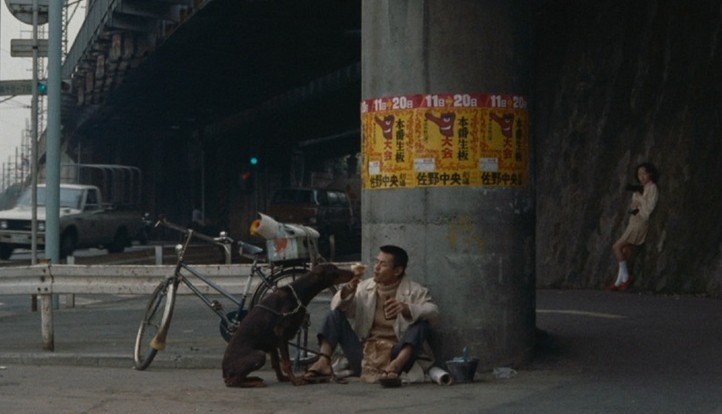
The young man responsible is Tenma (Kentarô Shimizu). It was an accidental occurrence (and Tenma not only seems a bit slow, but also has a foot-related disability), but Hayato confronts him nonetheless. What follows is entirely unexpected. Tenma describes his desire to rise about his low social standing and wants to be a boxer. Looking for any kind of reason to move forward with his life, Hayato agrees to train the youngster and help him begin a career in the minor boxing ranks. They ultimately do find some success, and both of the men begin to garner more attention and respect from those around them.
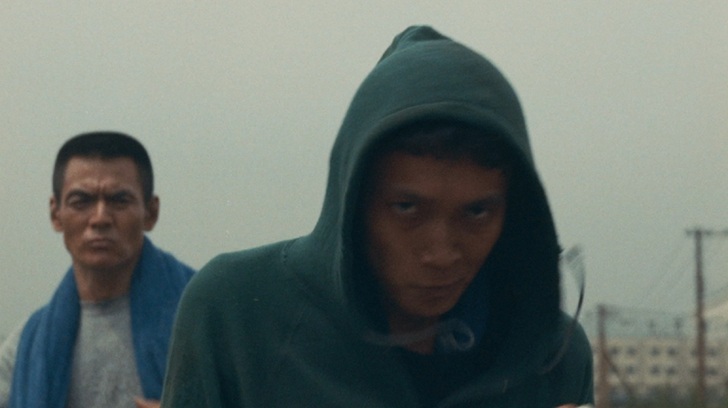
You can certainly see a few similarities here with Rocky. Hayato is a very angry spin on Mickey, while Tenma’s demeanor is in some ways similar to Rocky. But there are also differences to be seen. The camerawork is observational, often spending time wandering with the characters as they take on simple tasks. There’s a simple but memorable moment with Hayato wandering down the street and being followed by a young boy with cigarettes. The two end up puffing together (or at least, with the little one acting it out) as they reach their destination.
And the tense relationship between Hayato and Tenma is interesting to watch. Despite being a boxer, young Tenma is an outcast even among pugilists, and it’s moving to see him struggle to earn their attention. The fact that his ankle is clearly still a problem also creates tension, especially during later sections when the fights become more intense and dangerous.
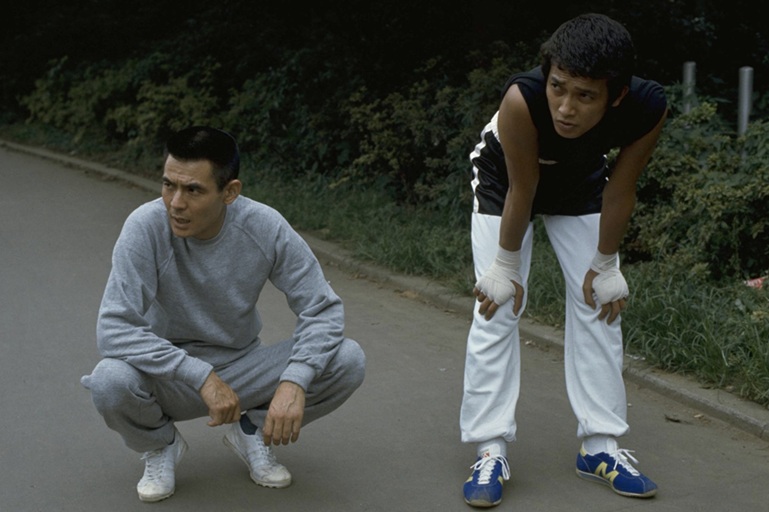
As for Hayato, the movie isn’t specific about why the lead gives up on himself in the ring. It can be interpreted in several ways, allowing the viewer to ponder it all as the story progresses. As a result, any thoughts the viewer might have are perfectly valid. Even though this isn’t necessarily the reason, the mood of the film did put a thought in my head about a career in sports, and how, for some it can end in incredible disappointment could also play a role Hayato and Tenma seem to earn the respect and admiration of those around them when they win, and we see instances where other characters are encouraging them to continue, although only for fame and financial reasons. But as soon as they fall, they are essentially tossed aside and ignored. And, for most, if this is the way that their careers will ultimately wrap up, why not end it on your own terms?
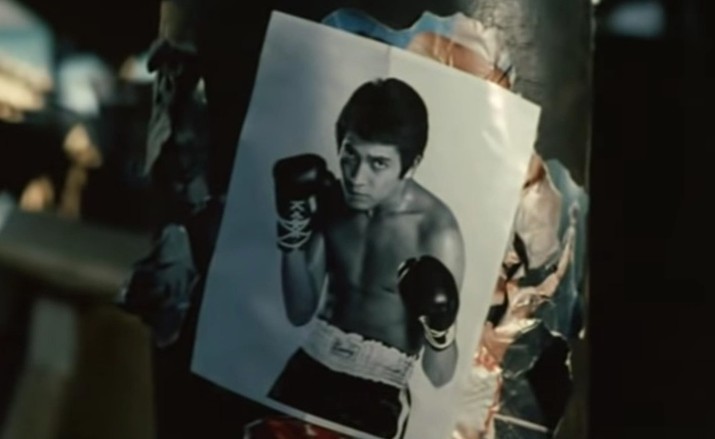
Whatever the case may be, the film doesn’t close on an entirely downbeat note. It’s filmmaker’s interesting approach to the material that ultimately leaves one thinking about these issues. This is a strangely compelling little movie with a unique tone and artfully crafted imagery and I quite liked it overall.
The film doesn’t appear to have ever been released before in this part of the world, so it’s quite remarkable that it is available on Blu-ray at all. Thankfully, the transfer is better than one might expect for a little-known feature. Toei has provided a high-definition digital file for this release. It does have a natural amount of grain, but it suits the grimier story set in a rundown part of town. And so, while it isn’t reference material, the image quality itself looks generally clean and pleasing throughout. While it won’t necessarily wow you, it is strong.
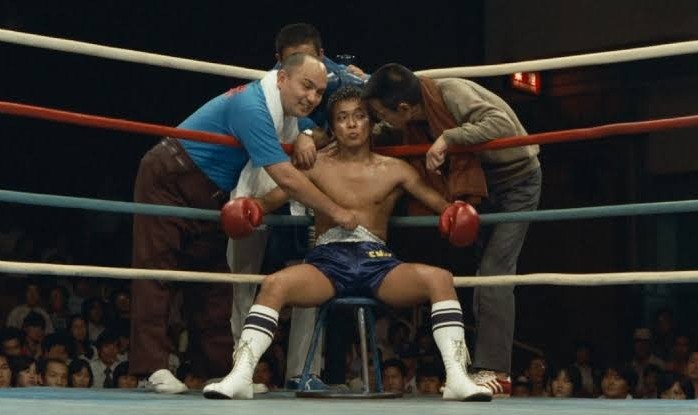
The disc also contains a couple of extras. The first is an interview with the film’s composer, J.A. Seazer. He discusses his experience meeting director Shuji Terayama (Emperor Tomato Ketchup, Death in the Country), who actually wanted to cast him in the picture with an acting role. After thinking about it, the artist decided scoring was of more interest. He also talks about his technique, and how he infused the film with a sound appropriate for the director’s more experimental tendencies.
Film historian Tom Mes does a piece on the Toei Company during the year 1977. This period produced one hit franchise with the first title in The Japanese Godfather series, but otherwise consisted of a series of commercial disappointments (The Boxer being one of them). It’s an interesting piece that shows how Toei was trying to adapt to changing times. Since American movies were dominating the box office over this period, it shows how they attempted to alter their product. There is also a bit of reexamination of some of the flops, which have aged well and carry their own distinctive feel.
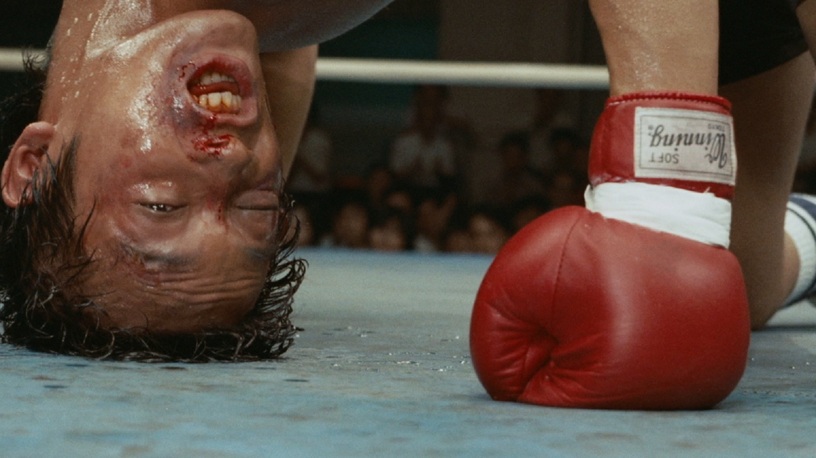
It also comes with a booklet containing more writing on the film and a reversible sleeve with artwork that is based on the film’s original posters.
If you enjoy sports films, The Boxer is a fine effort that is well worth your while. The film’s interpretive aspects stick with you long after credits, allowing you to ponder the motivations of the characters and what it means to be an athlete. This Blu-ray is also another solid, well-produced effort from Radiance Films with a good picture, and it comes recommended.
