
This “Limited Edition” 4K Ultra HD disc from Arrow Video is currently available for purchase.
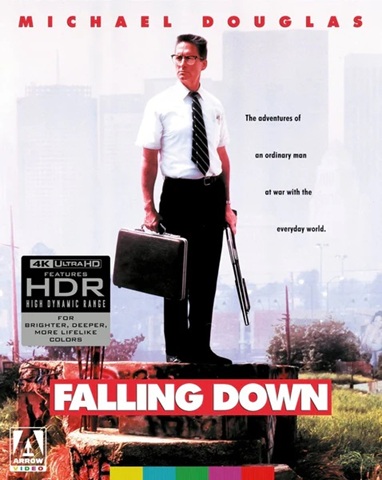
Back in 1993, the Los Angeles-set drama Falling Down generated a great deal of controversy upon its release. Following a man on a violent rampage through the busy city as he cites his grievances (and prejudices), the movie most certainly tapped into a tense and unsettling time in LA. The Rodney King riots had occurred less than a year earlier, and some audience members and critics were disturbed by what they were witnessing onscreen.
The movie was very successful and more than 30 years later, still feels like a remarkably relevant picture. I initially saw the film as a teenager. Upon revisiting it, many of the themes and ideas presented make a much stronger impact. This appears to be the case with many others too, as Falling Down has developed an even larger following over the years. Now Arrow Video is presenting the film with a 4K restoration from the original 35mm negative, approved by cinematographer Andrez Bartkowiak (Terms of Endearment, Speed, Dante’s Peak) and presented in Dolby Vision. It’s another striking image upgrade that will impress those who admire the movie, adding more striking detail to the presentation than ever seen before.
And it’s not just the story that is unique about the picture. The director, Joel Schumacher, was also an unusual choice to helm it. He was mostly known for features targeting a young demographic like St. Elmo’s Fire, The Lost Boys, Flatliners and Dying Young. Falling Down was a complete left turn and one that ended up suiting the filmmaker surprisingly well.
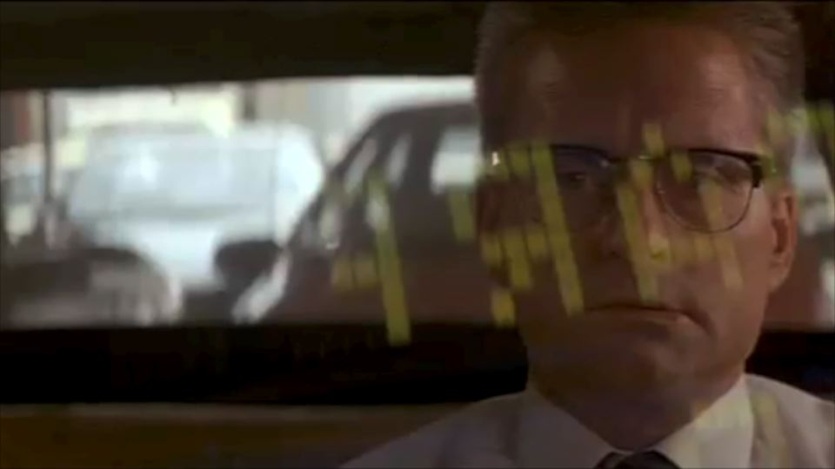
While trapped in busy LA traffic, a mysterious and clearly frustrated man (Micheal Douglas) shuts his car engine off, opens the door and walks right off the highway. As events progress, officials looking for him only have one clue as to his identity. His license plate, which reads “D-Fens” (who the character will be referred to from this point forward).
D-Fens walks into a corner store and gets into a very ugly argument with the Korean owner, eventually taking his baseball bat and using it on items. He then wanders into gang territory, walking out of the fracas with an automatic weapon. As the lead character moves from location to location, he lashes out more and more. In the meantime, a cop named Prendergast (Robert Duvall), takes on the challenge of finding D-Fens and stopping him. Over the course of the investigation, he discovers that the man was once an employee of the Defense Department, who was laid off and is trying to cross town to visit his estranged ex-wife and daughter for a birthday.
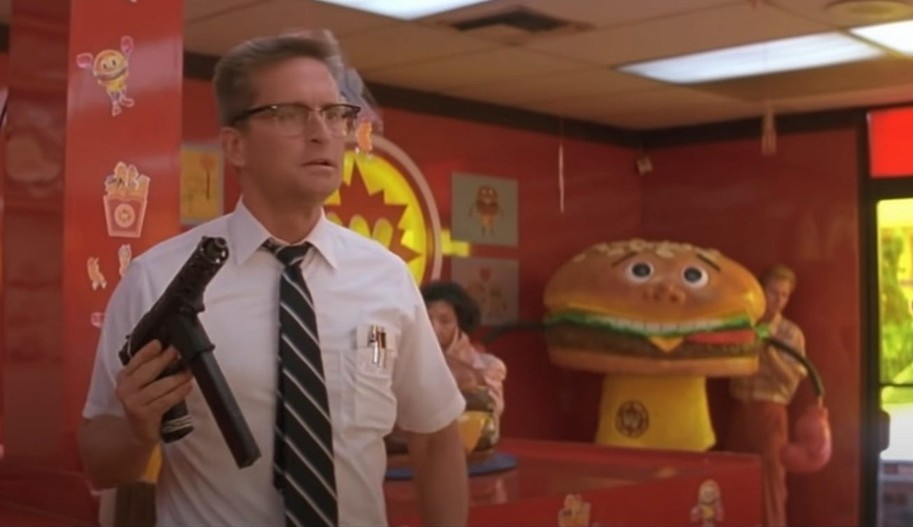
As noted, the film is tense throughout. While one can relate to the character’s initial frustration at being stuck in traffic, his increasingly unhinged and violent behavior becomes wildly unpredictable and distressing. Some of his outbursts, like the one at a fast-food restaurant who have just changed their menu for the day, are darkly amusing, while others are simply unsettling. This includes an encounter with an employee (Frederick Forrest) at an army surplus store, who turns out to be a Neo-Nazi. D-Fens is disturbed that his actions appear relatable to the fascist, and the anxious scene eventually takes a grim turn.
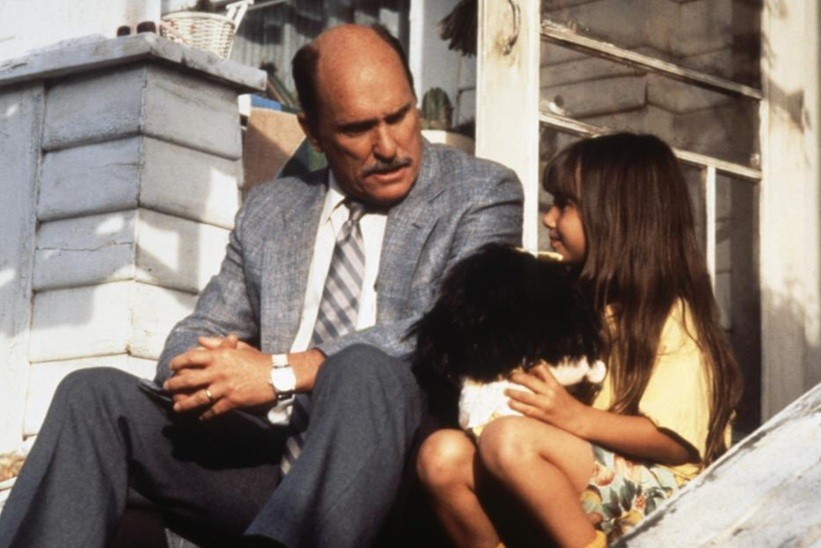
Everything about the movie seems designed to spur controversy and conversation, and it is ultimately clear that the behavior of D-Fens is not to be admired or emulated. This is a man going through the process of struggling through a mental breakdown, while the officer chasing him deals with all of the same characters in a more tolerant and low-key manner. In fact, the detective has been through his own set of personal trials, but manages to maintain his decency throughout.
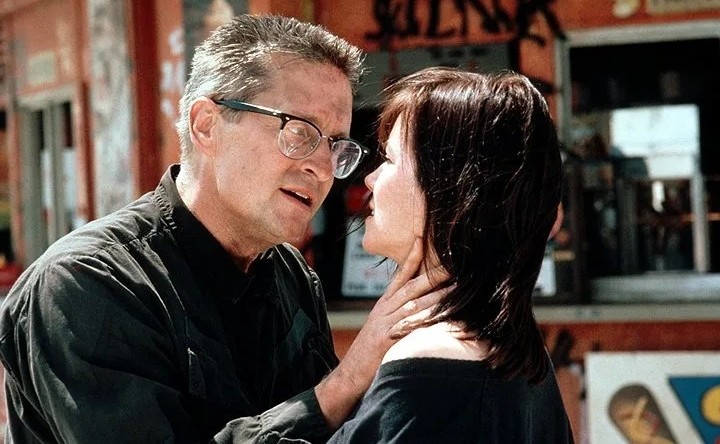
The movie looks stunning, with the photography capturing a sense of claustrophobia and heat in the big city. You can now see every bead of sweat pouring down the face of D-Fens (and the cracks in his glasses), and the intense temperature’s effect on many of the other characters as well. The background city details are also much sharper, and overall, this is an incredibly impressive disc that adds a lot of new and fine details to the presentation.
The new and archival bonuses are also illuminating to watch. The first new extra is a talk with screenwriter Ebb Roe Smith. Smith was a working actor in Hollywood at the time who was also trying his hand at screenwriting. One day, he heard about a truck driver losing his cool and plowing through gridlocked vehicles during a news broadcast. While he could relate to being stuck in traffic, it was a horrific story that he altered for the film. Smith instead started his tale with a man leaving his car in traffic, and then followed him throughout the day.
Smith notes that it took a lot of work to figure out how to slowly reveal his backstory, and also mentions that once the script reached studios, it became a hot property. He also discusses the changes that were made to his initial draft, and states that they were actually all beneficial to the final product. You’ll also learn that Smith has a cameo in the picture as the driver behind D-Fens who acts as a witness when the police arrive. The only thing the writer laments is that a few fans on the far-right appear to relate too closely to the main character (presumably missing the point of the movie).
There is also a new interview with composer James Newton Howard, who goes over how he was enlisted for the project and the approach he took to creating the music.
Additionally, you will get a featurette that examines the locations used in the film and what they look like today. Like many of these kinds of specials, it’s fun, although it is also clear a good portion of the city has radically changed (and been gentrified) over the years.
Typically, the best commentaries are the ones that come from the participants, and so this release includes an archival track from director Joel Schumacher, editor Paul Hirsch, screenwriter Ebbe Roe Smith, LA Times writer Shawn Hubler, and actors Michael Douglas, Michael Paul Chan, Vondie Curtis-Hall and Frederic Forrest. Schumacher is an excellent speaker here, going on about his reaction to the script, and how he wanted to present two alternate versions of the same kind of character. One is D-Fens, who ultimately indulges in his darker instincts and whose life ultimately comes to a quick end because of his inhumanity. The other is Prendergast, the detective who responds to the tension around him with tolerance, resulting in a much healthier character whom the audiences should aspire more to be like.
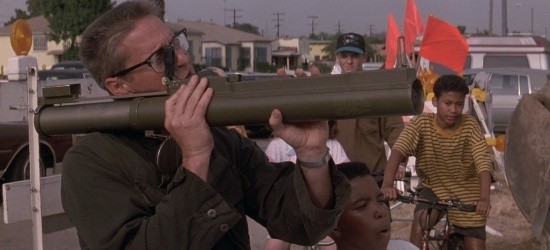
Schumacher discusses being passionate about the project and convincing the studio to allow him to helm (during an early extra, the screenwriter claims that the filmmaker agreed to direct the movie on the condition that he also helm Batman Forever for them, but that isn’t confirmed by Schumacher). The film’s star, Douglas, notes that he was excited at being asked to play a villainous character, which was rare for him at the time. They also go into detail about some of the changes made to the script and why they chose to do so.
Douglas also appears in an archival set of interviews, talking about how he interpreted the character and how he chose to play him in the film. The bits also include the performer talking about what a powder keg the city was sitting on during production. They were shooting during the Rodney King trial and did have to evacuate quickly when riots started occurring. Douglas claims that the tenuous, real situation around them fed into the film’s atmosphere and that is likely part of why it made such an impression.
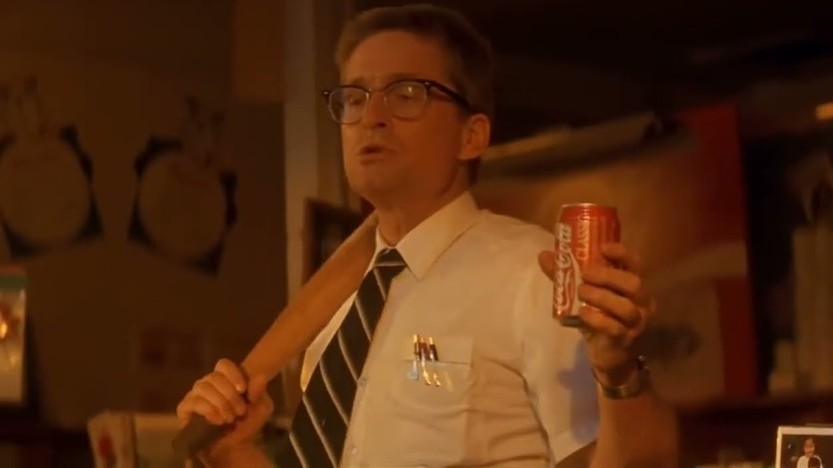
A trailer and an image gallery are also included, detailing how the picture was sold to the public upon its release.
Finally, you’ll also receive a booklet with new writing on the movie and how it continues to make an impact on home audiences today.
Falling Down is a movie that still feels as important today as it did more than thirty years ago. It is likely Schumacher’s best picture. The image quality on the disc is top-notch and the movie has frankly never looked as good as it does here. And the extras are very clear in revealing the moviemaker’s intentions and how it all came together. This “Limited Edition” 4K Ultra HD release from Arrow Video is fantastic and anyone who appreciates the movie should purchase it immediately.
