
This “Limited Edition” 4K Ultra HD (with bonus features on an accompanying Blu-ray) is now available from Arrow Video.
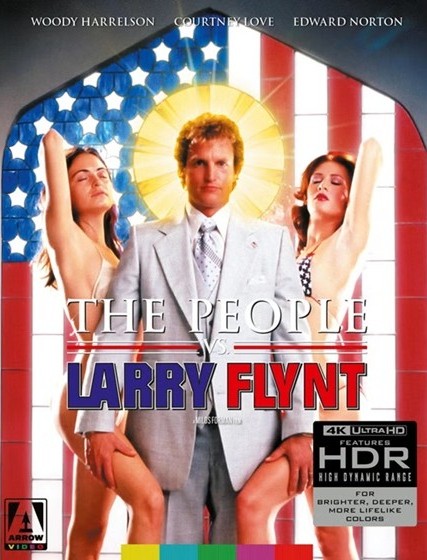
During the Oscar awards season of 1996, no film generated as much controversy as The People vs. Larry Flint, a biopic mixing drama and satire that told the fascinating story of the notorious publisher of Hustler magazine. The movie struck a nerve, earning raves from most critics, while being campaigned against by the likes of activist Gloria Steinem. I saw it at the theater during its original release and was impressed, and the film earned Academy Award nominations for its director and lead actor. Unfortunately, the heated protests that occurred during its release ended up hampering its success both at the box office and domestic award ceremonies.
It’s really too bad, as the picture was incredibly clever in the way it told the story of its main character. It didn’t paint Flynt as a hero and kept his motivations and life choices questionable, but was incredibly sharp and astute in pointing out that, to live in a free society, you often have to accept the views of others and be tolerant, even for things that you might find tasteless. The story is every bit as compelling as ever and the film couldn’t be more relevant today.
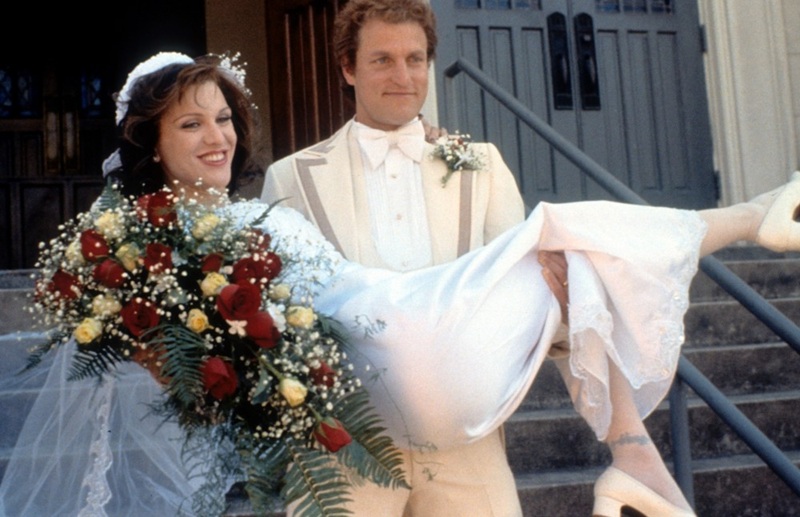
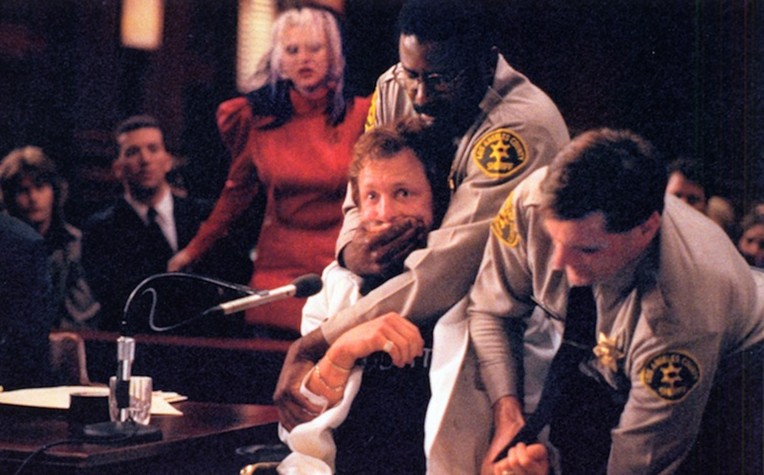
First off, it should be noted that this 4K disc looks phenomenal (the stills featured on this review don’t do it justice). This isn’t a science-fiction epic, but the image is incredibly clean and crisp. The film was restored in 4K from the original motion picture negative, and is presented in Dolby Vision. There is plenty of depth in this presentation, whether one is looking at a seedy bar, an overly decorated office complex, an enormous mansion with every luxury imaginable, or a courtroom. I can’t imagine the movie looking any better than it does right here, and I did see it on the big screen thirty years ago.
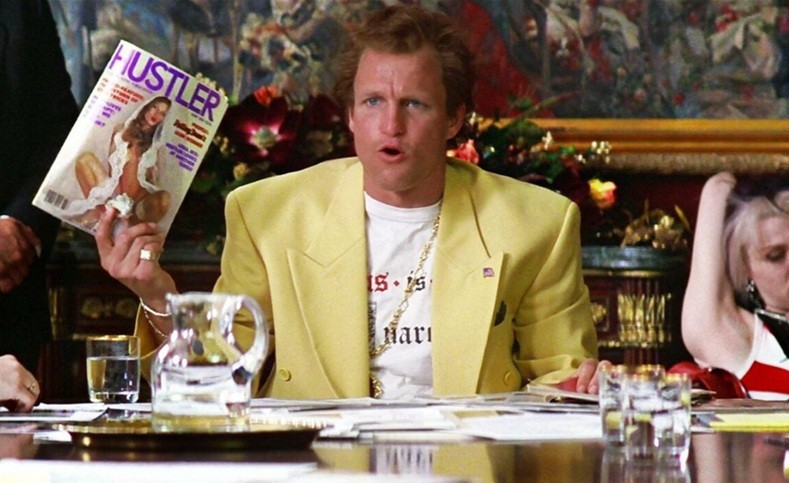
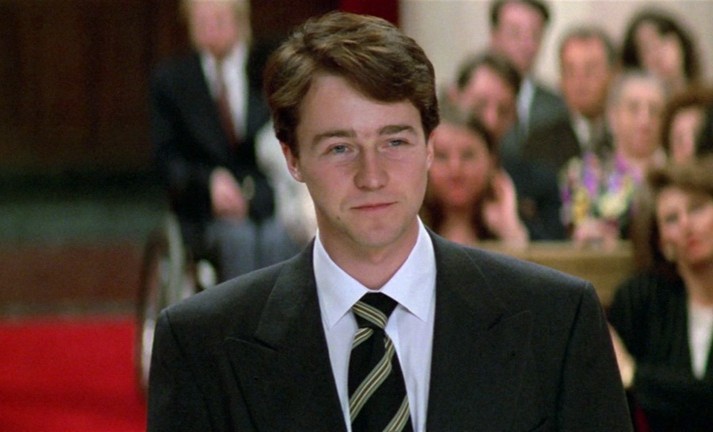
For those unfamiliar with the story, the plot shows how Larry Flint (Woody Harrelson) and his younger brother Jimmy (played by the star’s brother, Brett Harrelson) rise from poverty in a Kentucky cabin.. They start their own successful go-go bar, but Flint has grander ideas and eventually creates Hustler magazine, which quickly gains popularity and disdain for its explicitness. At one point, Flynt states that, unlike the high-minded Playboy, he has created an adult publication for the average working man. As his empire grows, he falls for Althea Leasure (Courtney Love). Hustler’s success inspires the moral majority to sue and prosecute Flynt, and young attorney Alan Isaacman (Edward Norton) is hired to defend the client. But Flynt’s outrageous behavior causes Isaacman nothing but headaches.
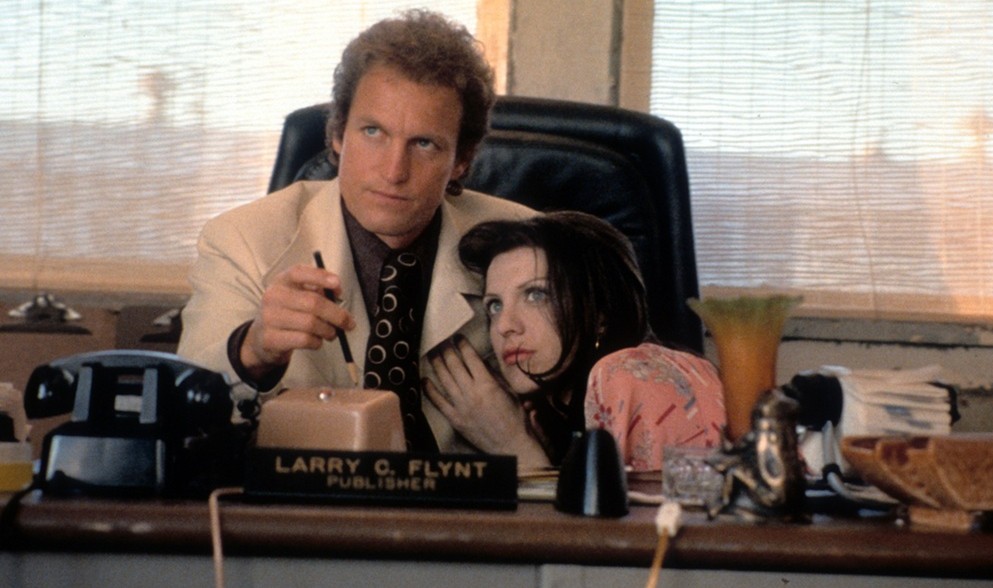
Indeed, Flynt’s crazy life takes several wild turns. He discovers God and decides to embrace Christianity, then survives an assassination attempt that causes permanent paralysis. The shooting also ends up resulting in a drug addiction problem. And, furious that there is little interest in hunting down the gunman (and the courtroom decisions that have gone against him), Flynt and Leasure begin writing political material, openly mocking the hypocrisy of his critics. He also locates and sends damaging footage of a few famous conservative figures to new reporters. After he publishes a satirical piece on televangelist Jerry Falwell, Flynt’s biggest and most important legal battle begins, and it goes all the way to the Supreme Court.

There’s a ton of material to deal with that’s so outrageous one wouldn’t believe that it could possibly be true. However, it is (and much more had to be left on the cutting room floor). The movie is paced in a zippy manner and features incredible performances. As mentioned, Harrelson doesn’t play Flynt as an admirable character. He’s deeply flawed and just about everything he does is in horrible taste, but it works as a drama. We are always fighting to get a read on what’s really going on in Flynt’s mind, and the story keeps up on the hook with every strange turn. All of the performances are naturalistic and completely convincing, including Courtney Love as wife Althea Leasure. Norton’s frustration is also fun to watch, as something bizarre occurs in the courtroom every time the lawyer fights to defend his client.
It’s all quite wonderful and, without being graphic, tells an important story that wouldn’t otherwise be known to most viewers. The movie also prompts discussion about free will and freedom of the press. It becomes evident that the minute one individual’s civil rights are taken away, it’s simply a matter of time before other regulations and restrictions follow for everyone else..
There’s another couple of reasons why the movie works so well. One is the script by Scott Alexander and Larry Karaszewski (who also penned Ed Wood, Man on the Moon and Dolemite is My Name), and the other is Oscar-winning Czech director Miloš Forman (The Fireman’s Ball, One Flew Over the Cuckoo’s Nest, Hair, Amadeus, Man on the Moon). In fact, everyone involved both in front of the camera and behind-the-scenes were experts in their fields working at the top of their game. This is a great film that suffered from misunderstanding upon its release and could certainly do with rediscovery.
Besides the phenomenal image quality, there are plenty of wonderful bonus features. The first are two archival commentary tracks. One features stars Harrelson, Love and Norton talking about how they were cast, their approaches to their complicated roles. They discuss working with Foreman, who utilized improvisation as much as possible while shooting in order to create a sense of realism to the story. It’s a fun track.
The second track is equally informative. It features writers Scott Alexander and Larry Karaszewski, who discuss becoming friends at USC and early attempts to get their screenplays produced. Apparently, their thesis idea turned into a script that was optioned by a major studio. It didn’t get produced, but the pair followed it up with Problem Child. That one got made, but heavily rewritten and critically lambasted. The two admitted that they were stuck as a result. They realized that they needed to start from scratch after pitching a clever story idea to a studio head who told them that their concept was great, but that they weren’t good enough writers to actually pen it. So, they went off and wrote a biopic of Ed Wood. Their luck changed when it crossed the desk of filmmaker Tim Burton, who loved it. Sony was going to produce the picture, but pulled out when Burton insisted on shooting the project in black and white. While the pair were thrilled that Disney picked it up, they were fearful during their first pitch session with Sony Pictures that there would be hard feelings.
It actually turned out to be one of the best meetings they’d ever experienced, with producer Janet Yang and ex-production president Lisa Henson being impressed with the idea. They also thought Oliver Stone would be interested in the project. Indeed, his company was and everyone worked together to get the picture financed and made. The commentary also contains great stories about how they research their biopics, what they wish they could have kept in to this telling, and more. Amusingly, they note that early on it was difficult to get an American director involved, but note that Europeans responded to the material properly and that they were lucky to land Forman. The two also go into the controversy around the film’s release and state their disappointment that the point of the film was not to promote pornography but free speech, and noted that Steinem’s attack was all about her personal hatred of Flynt rather than the film and its clear intent.
There are several lengthy new interviews that go over the same kind of material. Scott Alexander and Larry Karaszewski return to discuss their feelings on the movie now and how well it holds up, with more great stories. Woody Harrelson gives a new interview in which he expresses his admiration for the experience and how much he still loves the film, also going into shooting with Forman and how the process behind creating the very convincing performances. Lisa Henson and producer Janet Yang tell their stories behind getting the project made, sending the script to Forman, and all of the unusual pieces coming together.
Additionally, there is a 2022 interview with French cinematographer Philippe Rousselot, who discusses how he shot the movie. Since Forman wanted improvisational conversations, the director of photography had to figure out how to light and shoot multiple actors at the same time so that the footage would cut together (instead of lighting and shooting a performer in one direction, then moving around and shooting the reverse with the other).

There is a wonderful interview with Miloš Forman on The Charlie Rose Show, from the time of the film’s release. He’s questioned about the controversy and gives a quiet but powerful response, noting the attacks on him and his disappointment that some appeared to be missing the point of the movie. As a man who lived through the horrors of Nazi and then communist occupation earlier in his life, he warns how easy it is to lose your civil rights, and that people may be taking their freedom for granted.
And there is an excellent 30-minute documentary on Larry Flynt narrated by Dennis Hopper, as well as an archival EPK, two short deleted scenes (that can be played with commentary), a trailer, TV spots, and an image gallery, as well as the treatment presented to Oliver Stone, and a copy of the script.
This release also includes a booklet with essays on the movie, as well as an introduction from the screenwriters. Finally, it all comes in a reversible sleeve with a slipcover.
Once again, Arrow Video has delivered an exceptional product to film lovers from a truly great filmmaker. The People vs. Larry Flint pushes buttons, but does so in an interesting and compelling manner, resulting in a wonderful movie that is just as relevant today as it was thirty years ago. The extras are plentiful and all are illuminating. This release comes with my highest recommendation.
