
This Blu-ray from Toy Robot is now available for purchase.
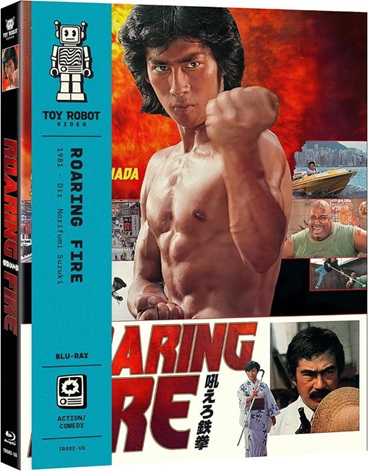
Some films are brilliantly executed and thought-provoking masterpieces that stand the test of time. Some pictures tell a more familiar story, but do so in such a skillful and slick way that we admire the craft and enjoy what they bring. And some movies are, well, so insane that we can’t help but appreciate the unique kind of madness that went into them. Such is the case with Roaring Fire, a Japanese action/martial arts picture with notable names that is arriving this week from new distribution label Toy Robot, who specialize in science-fiction, fantasy and cult titles. If this is the kind of material they’ll be bringing to audiences in the future, I cannot wait to see more from this outfit.
This Japanese production appears to be combining elements from James Bond spy pictures, adventure films, Hong Kong martial arts tales, wild 80s comedies, and to some degree, war movies. The results are so strange and what occurs during the story is so over-the-top that one can’t help but be glued to the screen throughout the entire running time. Toy Robot is presenting the film on Blu-ray for the first time in North America. While nowhere do the specs state that the original 35mm negative has been given a 4K restoration, the picture has been transferred from the best available elements and it looks very appealing for what it is… a scrappy, completely bonkers action picture that will frequently leave your jaw on the floor.
So, let me try to sum up what you’ll see when you pop this flick into your player. It begins with the first-billed star of the movie being hunted and gunned down by a gang in the streets of Hong Kong. Cut to a ranch in the USA, where the same actor plays Japanese ex-pat and cowboy Joji Hibiki (Hiroyuki Sanada). When he’s not rustling cattle, he spends his free time with a pet monkey. Out of the blue, Joji’s dying dad tells him that he isn’t actually his father. In fact, his real parents were murdered, and his surviving family, including a twin brother and a sister, live overseas. The guardian continues by stating that Joji’s twin has recently disappeared. So, the protagonist heads off to Japan to reconnect with family and try to find out where the brother could be. As the trail heats up, Joji finds himself racing around Hong Kong.
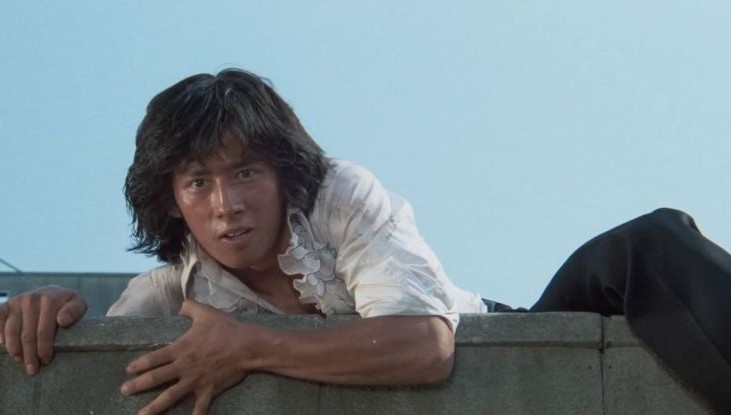
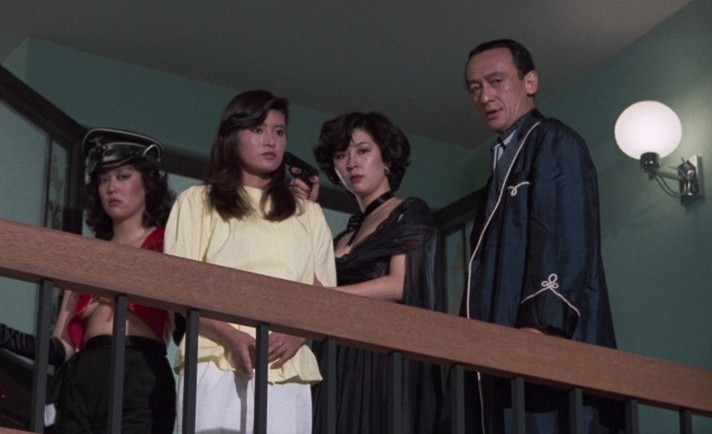
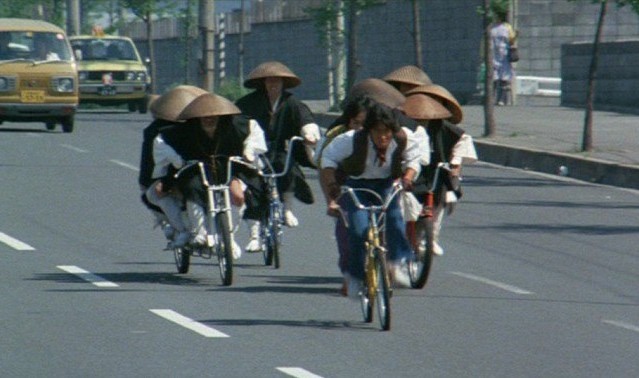
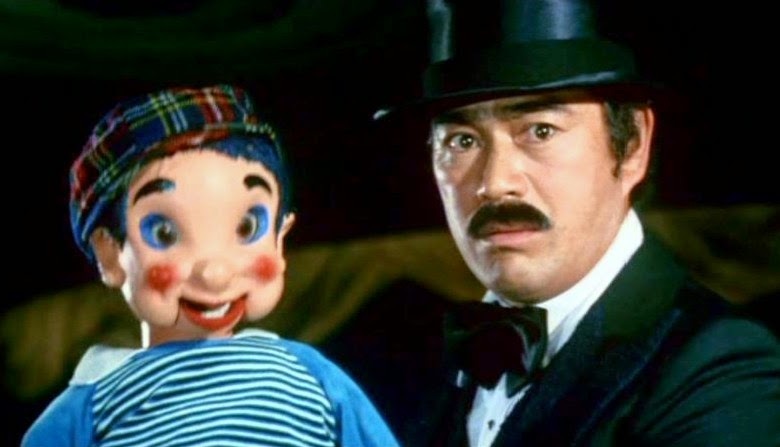
From the very beginning Joji gets into some silly trouble. This occurs when his monkey steals the bikini top off of a female swimmer and raises the ire of a security guard (Abdulla the Butcher). However, he does eventually reconnect with his blind sister Chihiro (Etsuko Shihomi) and concerned uncle Ikeda (Mikio Nartia). Joji also encounters and befriends a helpful magician/ventriloquist (Sonny Chiba) with secrets of his own. It isn’t long before it becomes clear that Uncle Ikeda is actually the head of a local crime syndicate, and that Joji’s brother was killed for failing to obtain a desired jewel called the Queen of Sheba. We also learn that Ikeda is also a Nazi who has a hidden lever in his mansion that opens up a hole in the floor, revealing a gas chamber. Joji and his team face off against ninjas employed by his uncle, as well as the family patriarch’s fascist pals.
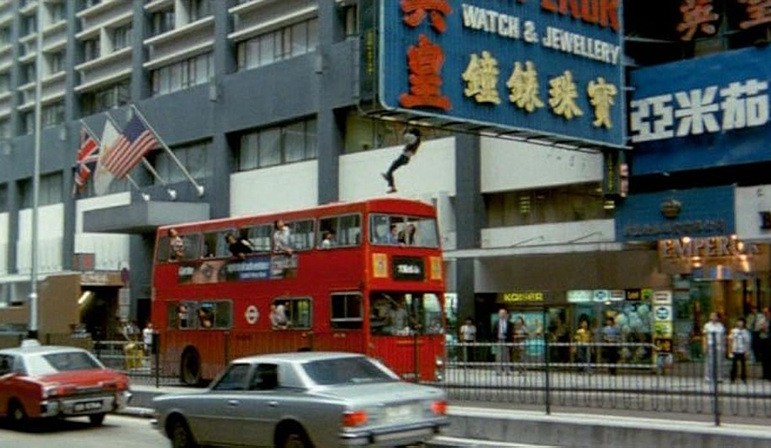
The end result is a fast-paced and completely bizarre effort that continually surprises with its never-ending strangeness. In some ways, I feel bad for giving away some (but not all) of the bizarreness that occurs here, because the movie never stops changing, well, everything about itself, from the tone to the plot elements. One thing the movie can’t be accused of is being boring. When conflict arises, from an alley show down to an oceanside martial arts confrontation the action is very impressive. Perhaps my favorite moment features a chase in which Joji ends up on the top of a double-decker bus careening through the streets of Hong Kong. The protagonist jumps, ducks under signs and even moves to the roof of another vehicle as he is being pursued. And, the aforementioned gas chamber bit is completely surreal, ending in a satisfying manner with a baddie receiving deadly payback for their crimes.
And that’s part of why this picture actually works quite well. It’s strange and not always in the best taste, but it is well-shot, action-packed and entertainingly unpredictable. Perhaps most importantly, it doesn’t take itself too seriously. It’s clear that anyone who appreciates a good-natured, and still berserk cinematic trip will get a kick out of it.
As noted, this isn’t a prestige title with legendary status, so the transfer is the best available. But the presentation looks quite strong when upconverted on a 4K Ultra HD player. There’s a natural, light grain present here and there, but nothing distracting, and some sequences (particularly those taking place in Hong Kong or around bright signage) look quite sharp and appealing. I found this to look generally pleasing.
There are also plenty of informative extras. In fact, it adds up to a significant amount of material that is a lot of fun to examine. The first bonus is a film historian commentary, which gives some background as to exactly what the heck was going on in Japanese cinema during this era. It seems that the country was making an effort to expand their audiences and embracing international productions. This kind of story, with various locales and references to other popular pictures at the time, was an attempt to appeal both to Japanese audiences and attract viewers from other countries.
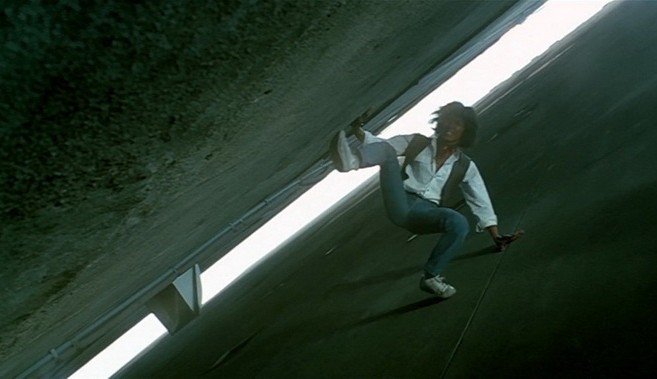
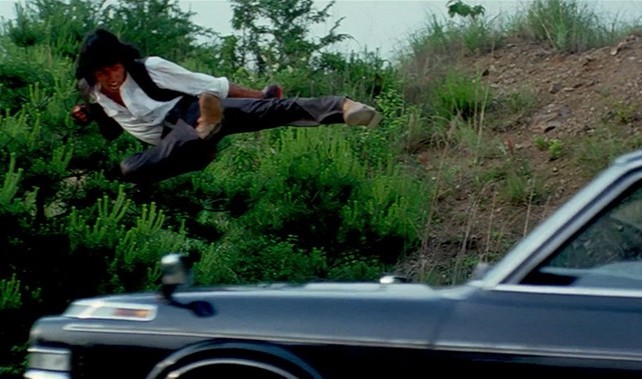
Admittedly, it didn’t play well abroad initially, but the picture still helped firmly establish young Hiroyuki Sanada as a leading man in his homeland (and he would later appear in major pictures like Ring, Spiral, Sunshine, The Last Samurai, Rush Hour 3, Speed Racer, The Wolverine, Life, the recent Mortal Kombat series, Bullet Train and John Wick: Chapter 4). The speakers also talk about the curious tone of the movie and what the filmmakers were trying to accomplish, as well identifying the elaborate stunts and how they were accomplished.
Additionally, you’ll get a featurette with a movie expert going over the career of supporting player Sonny Chiba. In this picture, the actor plays a magician/ventriloquist with a mysterious, spy-related background who offers Joji advice and support. This extra goes into far more detail about the actor and his work in cinema. Lead actor Sanada was a protégé of Chiba, and Chiba was a famous worldwide name for his Street Fighter movies, so it was only natural that he was asked to participate in the production. Chiba had been interested in moving into directing at the time and even helped choreograph some of the action scenes.
Another film critic (who appears frequently on the recent Arrow Video Jackie Chan boxset) gives his thoughts on the picture and all of its eccentricities, calling it one of the “wildest and craziest” films of the 1980s. He also notes that the filmmakers were essentially creating a stew of popular cinematic trends of the day, citing references to Indiana Jones, Jackie Chan and other popular trends of the period.
There is a featurette on the life of ex-pro-wrestler Abdullah the Butcher, who was a Canadian performer named Larry Shreve. You’ll learn how he ended up adopting his ring persona, as well as some of the extreme acts he performed in his shows. So much so, that he was often in character in public and feared by many whom he came into contact with (although in this picture, he takes on a lighter and funnier persona). There are plenty of interesting facts and stories relayed about his lengthy career from an authority on the subject.
And, there is another interview with a French cinema expert about the movie. He goes into Sanada’s ascent into superstardom (so much so that the performer often sang the theme songs for his pictures, as he does in this effort), which began with Roaring Fire. You’ll also get an overview of the Hollywood and international titles the actor appeared in. The historian also notes the many professional connections between the many cast members and offers more interesting details about the movie and its history. I enjoyed his analysis of the movie.
Amusingly eccentric theatrical trailers and TV spots are also included on this release.
It all comes packaged in a reversible sleeve, art cards and more.
Personally, I am thrilled to have been introduced to this nutty Japanese effort and strongly believe that, if more people in this part of the world see it, the film will become a cult movie. It is the right amount of crazy without being too bewildering, and the impressive, yet likable cast and great action make the entire experience a blast to watch. Toy Robot looks to be a great distributor, and they have done a wonderful job with the new Blu-ray of Roaring Fire. I can’t wait to see what they’ll be dropping on us next!

[…] Roaring Fire (1981) is an enjoyably bizarre and nutty martial arts movie from Japan with a plot that’s hard to sum up in a couple of sentences (but I’ll try). A Japanese cowboy living in the US with his pet monkey learns that his twin brother (that he never knew about) has been killed. He travels to Hong Kong to meet family members and stays with his uncle, a hugely successful businessman. Alas, the protagonist’s uncle turns out to be a neo-Nazi with a gas chamber in his mansion and growing army of gangland supporters. He is in search of a valuable diamond, and the hero does all he can to stop the baddies using his martial arts skills. This absolutely insane picture stars Hiroyuki Sanada, Sonny Chiba, Etsuko Shihomi as well as wrestler Lawrence Shreve aka Abdullah the Butcher. Naturally, this is the first time it has been released in this part of the world, and the Blu-ray disc contains a 1080p transfer, a film historian commentary, a critic discussing the career of Sonny Chiba, a movie expert overview of the movie, a look at the career of Abdullah the Butcher, another featurette on the production, trailers and TV spots. Read a full review of the release right here. […]