
Running Time: 112 minutes

This feature from Sony Pictures will open exclusively at theaters on October 9th.
Back in 2010, David Fincher’s The Social Network told the story of the rise of Mark Zuckerberg and the Facebook social media platform. It was a box office smash that earned eight Academy Award nominations, eventually winning for Best Adapted Screenplay, Best Score, and Best Editing. This follow-up, The Social Reckoning was written and directed by Aaron Sorkin (who was the screenwriter of the original film). It’s an important story that doesn’t focus on Zuckerberg, but a whistleblower at his organization. But while generally engaging and worthy, the final result doesn’t flow quite as flawlessly as the previous effort.

The main story jumps around from various events in a timeline mostly set between 2019 and 2022. It begins with reporter Jeff Horwitz (Jeremy Allen White) being hired by the New York Times to compose a story on tech giant Facebook. Meanwhile, at Facebook, Frances Haugen (Mikey Madison) is working in the company’s Civic Integrity Team. She diligently tries to keep misinformation from spreading on the platform, but discovers many disturbing issues with the content being uploaded. After being blown off by her boss Teddy (Billy Magnussen), she receives an email from Horwitz asking about these issues. Frustrated, the employee decides to become an informant. The reporter is grateful for her help, but also explains that he can’t report about her claims without concrete proof. As Horwitz is slowly given evidence, the film moves to icy Facebook president Mark Zuckerberg (Jeremy Strong) and his legal counsel preparing to testify before Congress on his company’s dire acts.
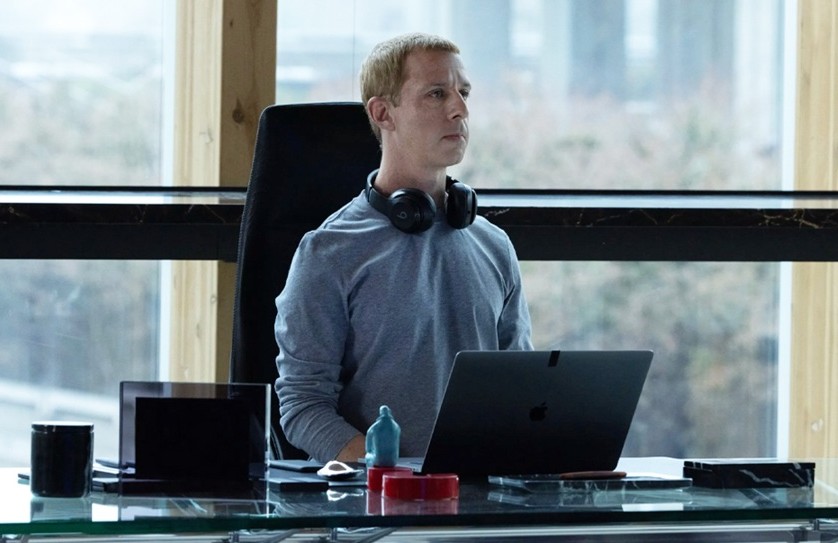
Horwitz doesn’t know Facebook jargon and terminology, and the film maximizes his lack of experience to draw viewers into the narrative. It allows for a lot of humor to be derived from reporter Horwitz’s ignorance, while also permitting less tech-savvy viewers the opportunity to learn alongside the journalist. While some of the details revealed will be familiar to those who read the original reports, it all still makes a strong impact as the main characters learn more about Facebook. Specifically, as they unravel the deadly effects of the social media company’s greed and their choices to ignore moral and ethical standards.
Haugen reveals a specific initiative undertaken by Facebook that is shocking as she analyzes the data and shares it with Horwitz. After a significant drop in the platform’s number of users due to new competition arriving on the scene, she realizes that the company’s algorithms focus on spreading extreme (and unverified) content, fostering anger and discontent to draw users back into the fold. While much of the storyline involves talking heads, there are several scenes that effectively display the effects of the new corporate policies and its manipulation of the public. This not only results in violent and hateful acts by adults, but an effective scene that shows the growth of cyber-bullying and its effect on kids.
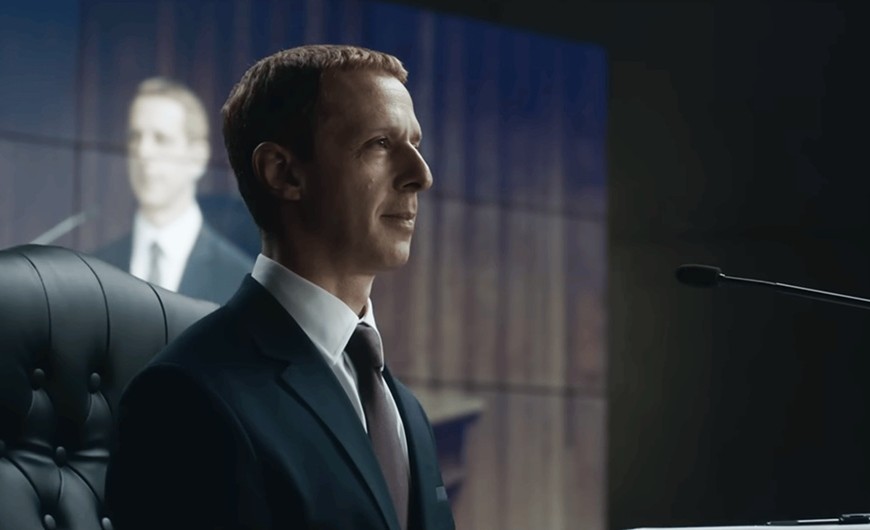
That aspect of the story is important. But as a narrative adaptation of real events, there are a few dramatic hurdles. Zuckerberg doesn’t directly interact with the protagonists, with most of his scenes involving prepping himself for testifying before Congress. Sorkin does his best to create dramatic tension here and there as Haugen attempts to maintain her anonymity from coworkers and her boss Teddy. But, because of what really occurred, even Teddy barely crosses paths with either of the two leads. On a narrative level, this fact flattens some of the drama.
And, while the performers are all quite good, a few casting choices don’t feel right. I could be mistaken, but the main characters appear younger than their real-life counterparts, to the point where it distracts, and they lack the gravitas one would hope for.

The points the film makes about Facebook/Meta and social media in general couldn’t be more relevant, and in my opinion are correct. And yet the narrative and characters can’t coalesce it all into a fully developed or perfectly-paced story. Still, Sorkin does put enough together to give viewers a lot to consider should they next visit the popular site. Most importantly, that one needs to verify what they are reading and hearing on social media with established and reliable news outlets. The Social Reckoning does succeed in emphasizing this point, at least making this feature worthy of a recommendation.
