
This “Limited Edition” Blu-ray from Radiance Films is now available for purchase.
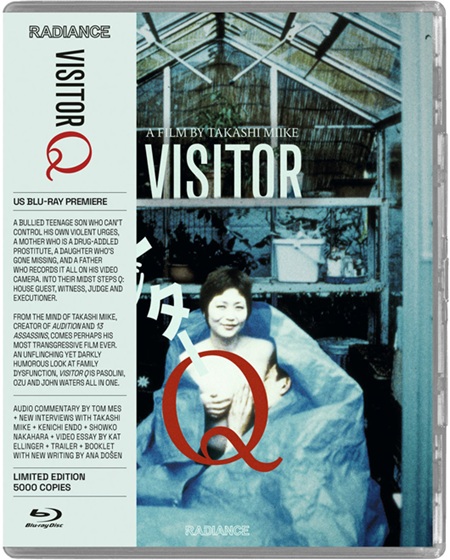
Japanese cult director Takashi Miike is one of the most prolific in the world. His career began just over 30 years ago, and in that time, he has made more than one-hundred features (including both theatrical and direct-to-video titles). That averages out to more than three films a year. Some are fantastic, including Audition, Ichi the Killer, One Missed Call, and 13 Assassins, some are interesting, and a few are well, a challenge to sit through. It’s only natural, especially with an output so massive, that some efforts are significantly stronger than others.
Visitor Q is one of Miike’s pictures that has split critics and audiences. It has a fervent following, but just as many who think the effort is among his worst. As someone who has never seen the picture, I didn’t have an opinion on it. Now, Radiance Films is releasing a “Limited Edition” Blu-ray of the title, so collectors can make up their own minds.
I’ll be honest and note that while I understand exactly what the picture is trying to do. It is attempting to raise its themes in a provocative manner to intentionally push buttons, but it’s not a story that I found relatable or engaging. In fact, many sections were difficult to endure. I suppose those who appreciate titles like Pier Paolo Passolini’s work, including the likes of Salo, or the 120 Days of Sodom might be enthusiastic about this effort, but for me it was a one-time-only viewing experience.
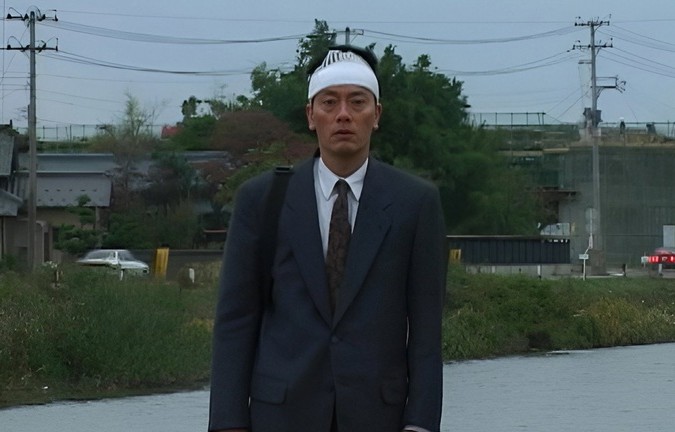
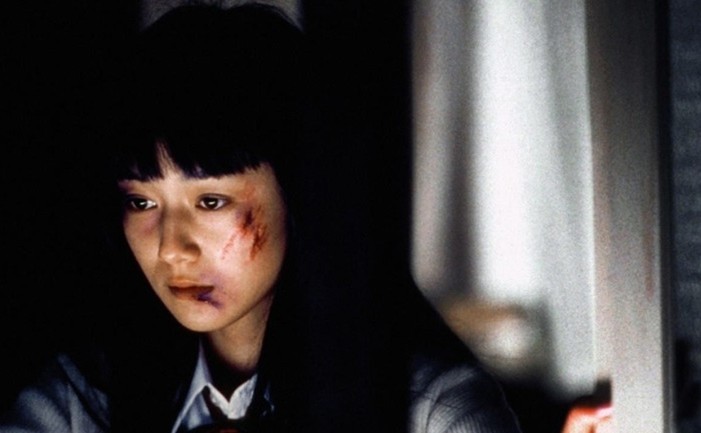
The plot follows what might be the world’s most dysfunctional family. The father, Kiyoshi (Kenichi Endo) is a television reporter who was sexually assaulted on the street while working on a story (why the cameraman or a random passerby doesn’t step in and stop the rape is never answered). Yet, Kiyoshi is an awful human being himself, and the film opens with a lengthy scene in which he solicits prostitute Miki (Fujiko) for sex. She also happens to be his teenage daughter. His son Takuya (Jun Muto) is bullied at school and violently beats mother Keiko (Shungicu Uchida) when he gets home every day. And even matriarch Keiko fills her days as a prostitute when everyone is out.
The four appear to hate each other, but things change when the mysterious Visitor Q (Kazushi Watanabe) knocks Kiyoshi unconscious with a rock to the head. He then helps the man get home and is invited into the household. The new arrival helps(?) the family by making them fully embrace their instincts. By the climax, Kiyoshi has murdered a coworker he’s been having an affair with, and partakes in necrophilia with the corpse. He receives help from wife during this part of the story, and the family form a true bond when they come together to kill Takuya’s bullies. The film ends with all of the characters in a happier state. In particular, Keiko rediscovers her mothering instincts by having all male family members drink her breast milk.
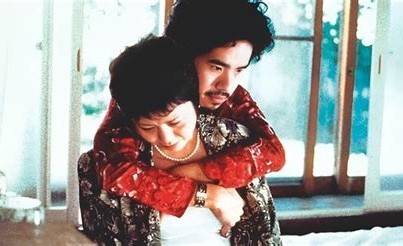
Good times! Well, the film does try to embrace comedy at points (particularly towards the end), and one can see potential in the concept of a dysfunctional family wrongfully attempting to correct past wrongs by coming together cohesively in order to commit crimes. But the movie starts off in such an extreme manner that one can’t relate to any of the characters. The film is shot on video and filmed almost as if one is watching security footage, which distances the viewer and prevents them from understanding why they are choosing to behave like this. Everyone at one time or another may have briefly imagined committing violence on a bully or a nasty figure, but otherwise all of these persons appear completely alien. There’s nobody to invest in. This is one instance where subtlety, with the characters even falsely trying to present a face of normality in the outside world before succumbing to these acts, might have drawn one into their world and the unsettling and disturbing dynamic. But it simply doesn’t happen.
This was a very low-budget project as well, resulting in various technical gaffes. Besides all the nastiness in the story, there are at least three scenes where the boom mike is clearly visible in frame for long periods of time. In fact, I’ve never seen a microphone visible on so many occasions for so long in a single movie. Again, it doesn’t do much to draw one into the story, characters, or make one think they’re watching anything other than a strange exercise simply designed to provoke a reaction.
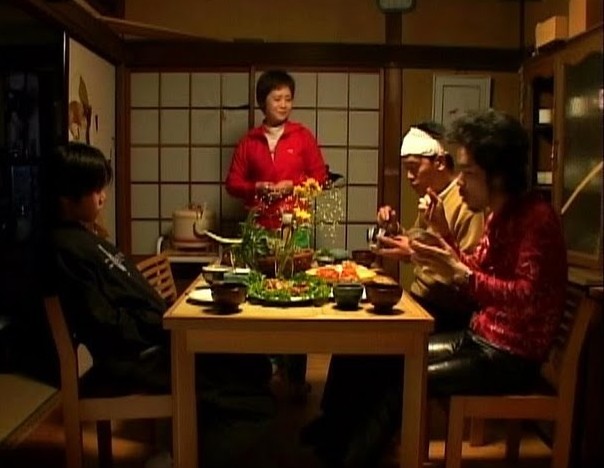
But, while this is a once only type of film for me, there is a large number who appreciate its transgressions. They should be pleased with the presentation. Again, the movie was shot on a video format common 25 years ago, but low resolution by today’s standards. Still, it all looks as clear as it possibly can under the circumstances.
There are also plenty of interesting bonus features. There is a commentary track with film historian Tom Mes, who is a defender of the movie, while also noting that many people hate it. He lays out his arguments and provides plenty of background information about the production, cast and films of the director.
And a lengthy 2026 interview with Miike himself is included, in which he goes into the origins of the project. Apparently, he was offered a low budget of somewhere north of $600,000 US to make the movie, along with the script and complete creative control. The director admits that what is going on is open to interpretation. He also details the challenges of making the movie. Miike believes that people really enjoy the picture and find it fun because they can relate in part to many of the inner desires of the main characters. Errr, I’m not quite sure I agree with that, but that’s his take.
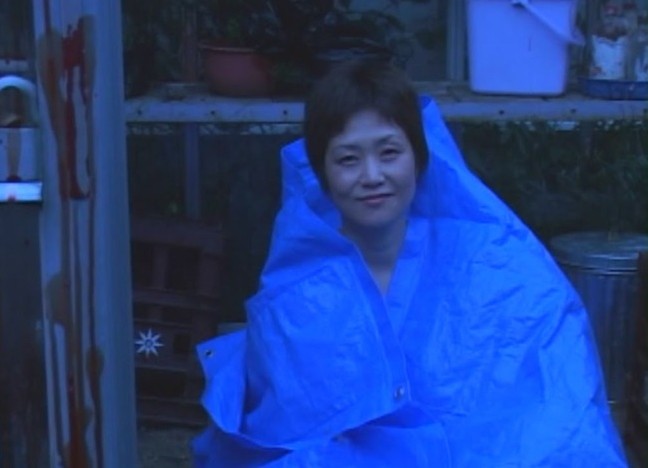
Star Kenichi Endo appears in a 2006 discussion, noting that he gets a lot of comments about this movie, and talks about this and other projects that he’s made with the filmmaker. There is also a new talk with Showko Nakahara, who plays the coworker that the main character murders and then has intimate relations with. She wanted to work with Miike and agreed to the part. They told her they’d let her know about casting her after looking into other options for the role. The performer laughs that, based on what she read, she knew no one would accept the part and that they’d be calling back shortly. And indeed, Nakahara was correct.
Finally, there is a visual essay from movie historian Kat Ellinger about how the movie is a tale of female empowerment. I’d agree to a certain extent and there are some good points included, but others that seem like a stretch (especially considering Miike’s own comments about the feature). Finally, a trailer is included.
There is also an insert booklet with more information about the title.
Visitor Q is most certainly not for everyone, myself included, but it does have a small following. This “Limited Edition” Blu-ray release gives viewers the best possible image quality, and arrives with plenty of extras that give a little more background about what’s going on. Those who appreciate the movie will be happy with the disc.
